
How Much Equity Do You Need to Remortgage in Canada?
 Dec, 1 2025
Most people think remortgaging is just about getting a better interest rate. But if you don’t have enough equity in your home, you won’t even qualify. In Canada, lenders don’t care how much you make if your home isn’t worth more than what you still owe. The gap between your home’s value and your mortgage balance? That’s your equity. And it’s the gatekeeper to every remortgage deal.
What counts as enough equity?
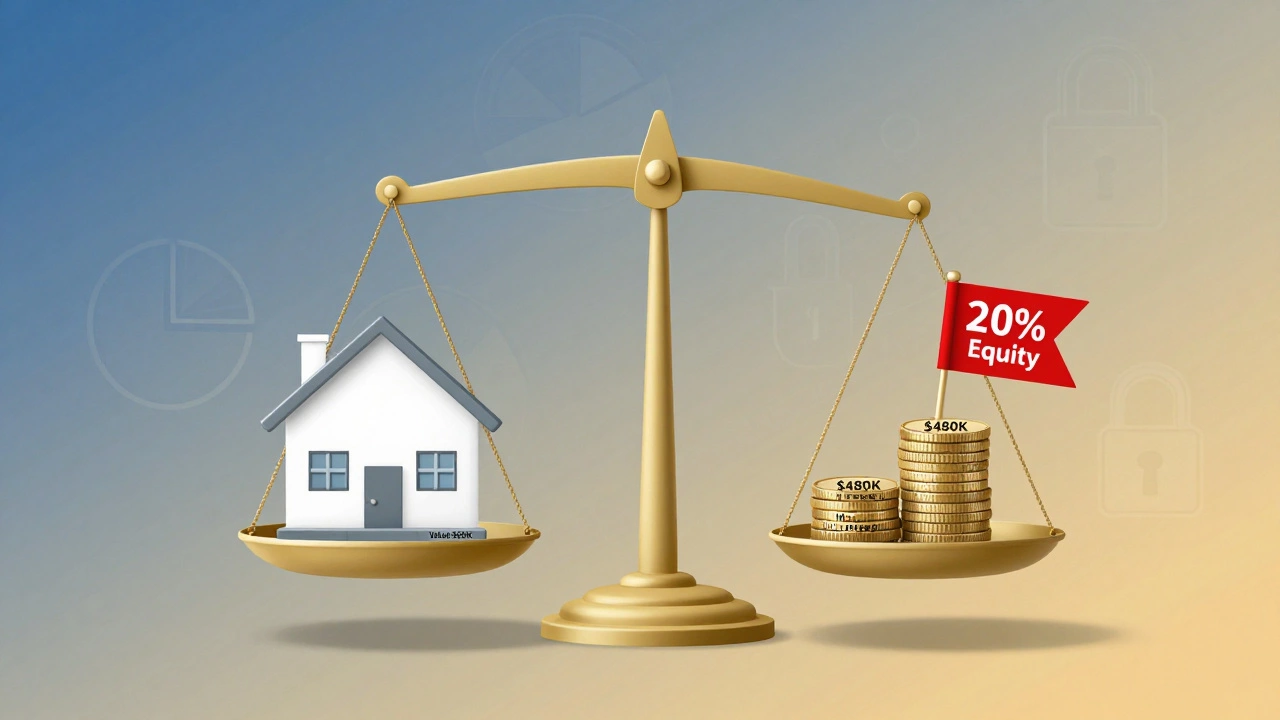
In Canada, the minimum equity most lenders require is 20% of your home’s current value. That means if your house is worth $600,000, you need to owe less than $480,000 on your mortgage. If you owe $500,000, you only have $100,000 in equity - that’s 16.7%. You’re below the threshold. No lender will touch you.
Why 20%? Because lenders use something called the Loan-to-Value ratio, or LTV. It’s the percentage of your home’s value that you’re borrowing. A 20% equity stake means you’re borrowing 80% or less. That’s the sweet spot. Anything above 80% LTV means you’re considered high risk. And that’s where mortgage default insurance kicks in - and most lenders won’t allow you to remortgage into a high-LTV loan unless you’re switching to a new lender who accepts it.
Some lenders will go up to 85% LTV if you have excellent credit and a stable income. But those deals are rare. They come with higher rates, stricter rules, and usually require a second mortgage or a co-signer. Don’t count on it.
How do you calculate your equity?
You don’t need a fancy calculator. Just grab your latest mortgage statement and a recent home appraisal or online estimate.
- Find your current mortgage balance. That’s what you still owe.
- Estimate your home’s current market value. Use Zolo, Realtor.ca, or a local realtor’s free valuation. Don’t guess - use real data from the last 6 months.
- Subtract your balance from the value. That’s your equity.
- Divide equity by value, then multiply by 100. That’s your equity percentage.
Example: Your home is worth $720,000. You owe $540,000. Your equity is $180,000. $180,000 ÷ $720,000 = 0.25. That’s 25% equity. You’re in the clear.
But here’s the catch: lenders don’t trust Zolo estimates. If you’re applying for a remortgage, they’ll order their own appraisal. And that appraisal could be lower than what you think. Always assume your home’s value will be assessed at the low end of the range. If you’re at 22% equity based on your estimate, treat it like you’re at 18%.
What if you have less than 20% equity?
You’re not out of options - but you’re limited.
If you have 15-19% equity, you might still qualify if you’re switching to a new lender who offers high-LTV remortgages. But you’ll pay more. Rates could be 0.5% to 1.5% higher. You’ll also need to prove you can handle the payments even if rates go up again. Lenders will stress-test you at 5.5% or higher, even if your current rate is 3.2%.
If you have under 15% equity, you’re likely stuck until you pay down your mortgage or your home rises in value. Some people try to borrow against their equity with a home equity line of credit (HELOC). But that doesn’t count as remortgaging - it’s a second loan. And if you’re already close to your limit, adding more debt could push you into default territory.
There’s one exception: if you’re remortgaging to consolidate high-interest debt - like credit cards or personal loans - some lenders might allow it with 10-15% equity. But they’ll require a detailed debt repayment plan and proof you’ve stopped using your credit cards. It’s not easy. And it’s not cheap.
How does your credit score affect your equity needs?
Your credit score doesn’t change the equity rule - but it changes your chances.
If you have a credit score above 720, you might get approved with 18% equity. If your score is below 650, you’ll need at least 25% equity to even be considered. Lenders see low credit scores as a sign you might miss payments. And if you’re already underwater on your home, they don’t want to take that risk.
One client in Mississauga had 17% equity and a 680 score. He was turned down by three lenders. Then he paid off a $12,000 credit card balance, waited three months, and his score jumped to 740. The fourth lender approved him with a 2.99% five-year fixed rate. He saved $4,200 a year. The key wasn’t more equity - it was cleaning up his credit.
When should you wait to remortgage?
Don’t rush. There are times when waiting makes more sense than forcing a remortgage.
- Your home value dropped in the last 12 months. Wait until it recovers.
- You’re within 6 months of your current term ending. Pay the penalty now and lock in a better rate then.
- You’ve taken out a home equity loan or line of credit recently. Wait until you’ve paid it down.
- Your income changed - you lost a job, switched to freelance work, or your hours were cut. Wait until you’ve got 6 months of steady income.
Many people remortgage too early because they see a lower rate online. But if you’re forced to pay a penalty, get stuck with a higher rate, or get denied, you lose more than you save.
What happens if you don’t have enough equity and you still want to remortgage?
You have three real options:
- Pay down your mortgage faster. Even an extra $500 a month can get you to 20% equity in 12-18 months. Use your tax refund or bonus to make a lump-sum payment.
- Wait for your home to appreciate. In Toronto and Vancouver, homes rose 5-8% annually from 2020 to 2023. If your area is stabilizing, you might hit 20% equity naturally in 1-2 years.
- Bring cash to the table. If you have savings, use it to reduce your mortgage balance. A $20,000 payment on a $500,000 mortgage with $420,000 owed drops your balance to $400,000. Suddenly, you’re at 20% equity on a $500,000 home.
There’s no magic trick. Equity is built over time - not found in a spreadsheet.
How do lenders verify your equity?
When you apply, they’ll ask for:
- Your latest mortgage statement (showing your balance)
- A professional appraisal (ordered by the lender)
- Proof of income (pay stubs, T4, or tax returns)
- Your credit report
The appraisal is the dealbreaker. If your home is valued at $580,000 instead of the $620,000 you thought, your equity drops. That’s why it’s smart to get a pre-appraisal before applying. Some realtors offer free ones. Use it to adjust your expectations.
Can you remortgage to access your equity?
Yes - and that’s the most common reason people remortgage.
If you have 30% equity, you can borrow up to 80% of your home’s value. That means you can take out cash - for renovations, debt consolidation, or even an investment property. But you’re not just remortgaging for a better rate. You’re increasing your total debt.
Example: Your home is worth $800,000. You owe $400,000. You have $400,000 in equity. You remortgage to $640,000 (80% of $800,000). You get $240,000 in cash. Your new balance is $640,000. Your equity is now $160,000 - or 20%. You still meet the minimum. But your monthly payment just went up. And you’re now more exposed if home prices fall.
Only do this if you have a clear plan. Don’t use it for vacations, new cars, or impulse spending. Use it to build long-term value.
What’s the biggest mistake people make?
They focus on the interest rate and ignore their equity.
I’ve seen people chase a 0.3% lower rate and end up paying $15,000 in penalties because they didn’t have enough equity to switch without a penalty. Others took out a HELOC thinking it was the same as remortgaging - then got stuck with two loans and no way out.
Equity isn’t just a number. It’s your financial safety net. The more you have, the more options you have. The less you have, the more you’re at the mercy of your lender.
Before you start shopping for rates, calculate your equity. Then ask yourself: Do I have enough to make this move? Or am I just trying to escape a bad rate by digging myself deeper?