
How Much Is a $100,000 30-Year Mortgage at 7%? Full Breakdown
 Jul, 13 2026
Mortgage Amortization Calculator
Monthly Principal & Interest
Total Interest Paid
$139,508
Total Cost of Loan
$239,508
Visual breakdown of annual payments by year
You’re staring at a price tag. Maybe it’s for a first home, maybe it’s a refinance to pull out equity, or maybe you’re just crunching numbers to see if buying makes sense right now. The headline number is $100,000, the term is 30 years, and the rate is 7%. It sounds straightforward, but that single percentage point hides a massive amount of money over three decades.
If you borrow $100,000 at 7% interest for 30 years, your monthly principal and interest payment will be $665.30. That’s the core number you need to budget for. But here’s the kicker: over the life of the loan, you’ll pay back $239,508 total. That means you’re paying $139,508 in interest alone. You’re effectively paying back more than double what you borrowed. Understanding exactly how that math works-and where your money goes each month-is the difference between being shocked by your statement and having full control of your finances.
The Math Behind the Monthly Payment
Where does that $665.30 figure come from? Banks don’t just divide the loan amount by the number of months. If they did, $100,000 divided by 360 months would be roughly $277.77. That ignores interest entirely. Instead, lenders use an amortization formula that accounts for the time value of money. Every month, a portion of your payment covers the interest accrued on the remaining balance, and the rest chips away at the principal.
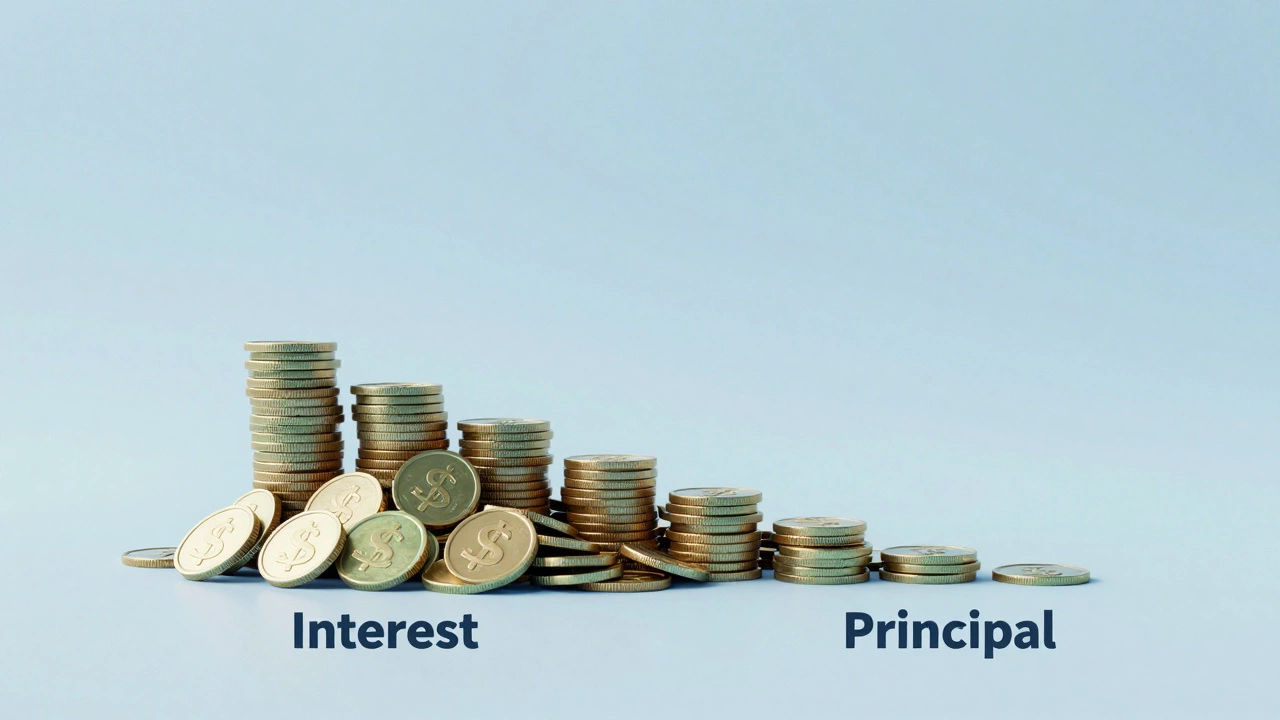
At the start of your loan, the interest charge is calculated on the full $100,000. Seven percent of $100,000 is $7,000 per year, or about $583.33 per month. So, in your very first month, out of your $665.30 payment, $583.33 goes strictly to interest. Only $81.97 actually reduces your debt. This front-loaded interest structure is why mortgages feel like they move so slowly in the beginning. You aren’t building equity quickly; you are mostly paying the bank for the privilege of holding the cash.
As you make payments, the principal balance drops slightly. Because the balance is lower, the interest charged next month is slightly lower too. That means more of your fixed $665.30 payment can go toward the principal. This cycle repeats for 360 months. By the end of the loan, almost every dollar of your payment goes to principal, with only pennies left for interest.
Principal vs. Interest: Where Your Money Goes
To truly understand the cost, you have to look at the split between principal and interest over time. This isn’t just academic; it affects your net worth and your tax situation (if you itemize deductions). In the early years, you are paying the bank. In the later years, you are paying yourself.
| Year | Total Paid | Interest Paid | Principal Paid | Remaining Balance |
|---|---|---|---|---|
| 1 | $7,983.60 | $6,943.18 | $1,040.42 | $98,959.58 |
| 5 | $39,918.00 | $34,626.55 | $5,291.45 | $94,708.55 |
| 10 | $79,836.00 | $66,224.12 | $13,611.88 | $86,388.12 |
| 15 | $119,754.00 | $92,855.33 | $26,898.67 | $73,101.33 |
| 20 | $159,672.00 | $113,556.89 | $46,115.11 | $53,884.89 |
| 25 | $199,590.00 | $127,556.44 | $72,033.56 | $27,966.44 |
| 30 | $239,508.00 | $139,508.00 | $100,000.00 | $0.00 |
Notice that after 10 years, you’ve paid nearly $80,000 into the loan, but your balance has only dropped to $86,388. You’ve built less than $14,000 in equity through payments. This is the "interest trap" of long-term loans. However, this also highlights the power of prepayment. If you throw extra money at the loan in those first five years, you slash the interest burden significantly because you reduce the principal base faster.
The Hidden Costs Beyond Principal and Interest
Your monthly check won’t actually be $665.30. That number covers only the loan itself. When you buy a home or refinance, there are other recurring costs that lenders often bundle into your monthly escrow account. These include property taxes and homeowners insurance.
In many markets, property taxes range from 0.5% to 2.5% of the home’s value annually. Let’s assume a conservative 1% tax rate on a $100,000 property. That’s $1,000 a year, or about $83.33 a month. Homeowners insurance might run another $800 to $1,200 a year, adding roughly $70 to $100 monthly. If you’re in a condo association, HOA fees could add another $200 to $500 depending on amenities.
So, while the mortgage note says $665, your actual monthly housing cost could easily be closer to $850 or $900. Lenders look at this total "debt-to-income" ratio when approving you. They want to ensure your total monthly debt payments don’t exceed 36% to 43% of your gross income. For a $850 housing payment, you’d generally need a gross annual income of around $23,000 to $28,000 just to qualify comfortably, though local norms and credit scores vary this threshold.
What Happens If Rates Change?
A 7% rate is a specific snapshot in time. If you lock in a fixed-rate mortgage, that 7% stays forever. Your payment never changes. But if you choose an adjustable-rate mortgage (ARM), things get volatile. An ARM might start lower, say 5%, but then adjust based on market indexes like the SOFR or Treasury yields.
If rates rise to 8% after five years, your payment on the same $100,000 balance would jump significantly. At 8% for the remaining 25 years, your new payment would be roughly $772. That’s an extra $100+ a month appearing out of nowhere. Fixed-rate mortgages provide predictability, which is crucial for budgeting. In an environment where rates fluctuate, knowing exactly what your payment will be in year 15 gives you peace of mind that an ARM cannot match.

Strategies to Pay Less Interest
Paying $139,508 in interest feels painful. Is there a way to avoid it? Yes, but it requires discipline. Here are three practical moves:
- Shorten the Term: Switching to a 15-year mortgage at the same 7% rate drops your monthly payment to $898.86. While that’s higher monthly, you’ll pay only $61,794 in interest total. You save over $77,000 compared to the 30-year option. The catch? You need the cash flow to handle the higher monthly bill.
- Make Extra Principal Payments: You don’t have to refinance. Just pay an extra $50 a month toward the principal. On a $100,000 loan at 7%, that small habit saves you about $18,000 in interest and pays off the loan nearly four years early. Most online banking portals let you designate extra payments as "principal-only" to avoid messing up your amortization schedule.
- Refinance When Rates Drop: If rates fall to 5% two years into your loan, refinancing can reset your clock. However, watch out for closing costs. Refinancing usually costs 2% to 5% of the loan amount ($2,000 to $5,000). You need to calculate the break-even point. If you plan to stay in the home longer than the break-even period, refinancing makes sense. If you’re moving soon, stick with the current loan.
Is a 30-Year Mortgage Right for You?
The 30-year mortgage is popular because it offers the lowest monthly payment, maximizing your purchasing power. You can afford a more expensive house because the monthly hit is smaller. This liquidity allows you to invest the difference elsewhere. If you can earn a return greater than 7% on your investments (like in the stock market over long periods), keeping the 30-year loan and investing the extra cash may yield a better financial outcome than paying down the mortgage early.
However, this strategy carries risk. Market returns aren’t guaranteed. Mortgage interest is a certain cost; investment gains are not. For many people, the psychological relief of owning their home free and clear outweighs the potential mathematical advantage of investing. There is no wrong answer here, only different risk tolerances.
If your goal is stability and low monthly stress, the 30-year fixed at 7% is a solid foundation. Just remember that $665.30 is just the tip of the iceberg. Factor in taxes, insurance, and maintenance, and you’ll have a realistic picture of what it truly costs to keep the lights on and the roof over your head.
What is the monthly payment for a $100,000 mortgage at 7% for 30 years?
The monthly principal and interest payment is $665.30. This does not include property taxes, homeowners insurance, or private mortgage insurance (PMI) if applicable.
How much total interest will I pay on a $100,000 loan at 7% over 30 years?
You will pay a total of $139,508 in interest over the life of the loan. This means you pay back $239,508 in total, which is more than double the original loan amount.
Does my payment change during a 30-year fixed mortgage?
No, with a fixed-rate mortgage, your principal and interest payment remains exactly the same for all 360 months. However, your total monthly housing cost may change if property taxes or insurance premiums increase.
Can I pay off a 30-year mortgage early?
Yes, most fixed-rate mortgages allow you to make extra principal payments without penalty. Making even small extra payments each month can significantly reduce the total interest paid and shorten the loan term.
What income do I need to afford a $100,000 mortgage?
Lenders typically require your total monthly debt payments to be less than 36-43% of your gross monthly income. For a $665 mortgage payment plus estimated taxes and insurance, you would generally need an annual gross income of at least $23,000 to $28,000, though this varies by lender and credit score.