
How to Get Student Loan Forgiveness: Eligible Programs and Steps for 2026
 Jun, 1 2026
Student Loan Forgiveness Eligibility Checker
Determine which federal forgiveness program might fit your situation based on your employment, loan type, and income status.
Imagine waking up one morning to find your $150,000 student loan balance has dropped to zero. It sounds like a dream, but for thousands of borrowers in the United States, it is a legal reality. However, getting student loan forgiveness isn’t as simple as signing a waiver. There are specific paths, strict eligibility rules, and common traps that can cost you years of progress if you miss them.
If you are looking to wipe out your debt, you need to know which program fits your life right now. Whether you work for a non-profit, have a low income, or serve in a specialized field, there is likely a route for you. But first, let’s clear up a massive misconception: most private student loans cannot be forgiven. These programs apply almost exclusively to federal loans.
The Golden Ticket: Public Service Loan Forgiveness (PSLF)
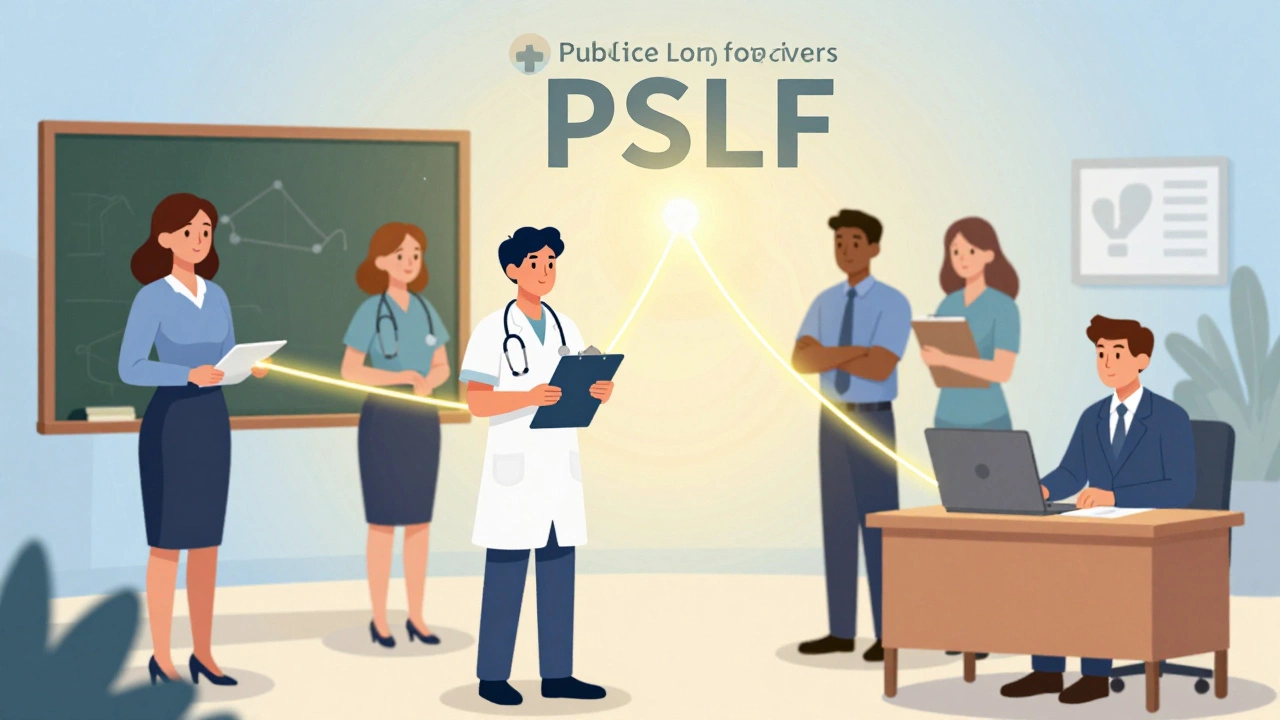
Public Service Loan Forgiveness is the most well-known path to clearing your debt. If you work full-time for a qualifying employer, you can get the rest of your loan balance wiped clean after making 120 qualifying monthly payments. That’s ten years of consistent effort.
Who qualifies? The definition of "public service" is broader than you might think. It includes:
- Government organizations at any level (federal, state, local, tribal).
- Tax-exempt non-profit organizations under Section 501(c)(3) of the Internal Revenue Code.
- Other types of non-profits that provide a public service, such as emergency management, public law enforcement, or public education.
The catch? You must be on an Income-Driven Repayment (IDR) plan. Standard repayment plans do not count toward PSLF unless your payment amount equals what you would pay on an IDR plan. Also, every payment must be made on time. One missed payment doesn’t disqualify you, but it delays the clock. Since the Department of Education introduced the Limited PSLF Waiver in 2021, many past errors were corrected, but you still need to submit a new application annually to stay on track.
Forgiveness Through Income-Driven Repayment Plans
What if you don’t work for the government or a non-profit? You can still get forgiveness through Income-Driven Repayment plans. These plans cap your monthly payment at a percentage of your discretionary income-usually 10% to 20%. Because your payments might be lower than the interest accruing on your loan, the government essentially subsidizes the difference over time.
After a set period of making these capped payments, the remaining balance is forgiven. Here is how long you have to wait depending on the plan:
- Income-Based Repayment (IBR): 20 to 25 years.
- Pay As You Earn (PAYE): 20 years.
- Revised Pay As You Earn (REPAYE): 20 years for undergraduates, 25 years for graduate students.
- Saving on a Valuable Education (SAVE): This newer plan often offers faster forgiveness because it calculates interest more favorably. For balances under $12,000, your payment could be $0, and the balance may never grow.
The trade-off here is significant. While the debt disappears eventually, the forgiven amount is considered taxable income by the IRS. This means you could face a hefty tax bill in the year your loan is cancelled. Always consult a tax professional before relying on this path.
Total and Permanent Disability (TPD) Discharge
Life happens. If you become totally and permanently disabled, you may qualify for a Total and Permanent Disability Discharge. This eliminates your Direct Loans, FFEL Program loans, and Perkins Loans entirely. To qualify, you usually need certification from a licensed physician stating that your disability is expected to result in death or has lasted, can be expected to last, or can be expected to result in death for a continuous period of not less than 60 months.
You can also qualify if you are receiving federal disability benefits, such as Social Security Disability Insurance (SSDI) or Supplemental Security Income (SSI), and you have been on a continuing disability review for at least five years. Note that this discharge does not cover Private Student Loans or Parent PLUS loans unless they were consolidated into a Direct Consolidation Loan.
Closing Schools and Borrower Defense to Repayment
If your school closed while you were enrolled or shortly after you withdrew, you might qualify for a Closed School Discharge. Similarly, if your school misled you about its accreditation, job placement rates, or financial aid policies, you can file a Borrower Defense to Repayment claim. This is a powerful tool for victims of predatory lending practices.
In recent years, the Department of Education has expanded these protections. If you prove that your institution committed fraud or serious misconduct related to your loan obligations, your loans can be discharged without penalty. Keep all correspondence with your school and any advertising materials you received; these documents are crucial evidence.
Teacher Loan Forgiveness
For educators working in low-income schools or educational service agencies, Teacher Loan Forgiveness offers a quicker payout. Unlike PSLF, which takes ten years, this program forgives up to $17,500 after just five consecutive full-time years of teaching. The amount depends on your subject area:
- $5,000 for general elementary or secondary teachers.
- $8,000 for special education, math, science, foreign language, or bilingual education teachers.
- $17,500 for highly qualified special education, math, or science teachers (this higher tier is rarely awarded due to strict "highly qualified" definitions).
This forgiveness applies only to Direct Subsidized and Unsubsidized Loans, as well as FFEL Subsidized and Unsubsidized Loans. It does not apply to PLUS loans or Perkins loans. You must apply within three years of completing your five-year teaching requirement.
| Program | Time to Forgiveness | Key Requirement | Taxable? |
|---|---|---|---|
| Public Service Loan Forgiveness (PSLF) | 10 Years (120 Payments) | Full-time public service job + IDR Plan | No |
| Income-Driven Repayment (IDR) | 20-25 Years | Low income relative to debt | Yes (usually) |
| Teacher Loan Forgiveness | 5 Years | Teach in low-income school | No |
| Total & Permanent Disability | Immediate upon approval | Medical certification of disability | No |
| Borrower Defense | Varies | School misconduct or closure | No |

Private Loans: The Hard Truth
If you have private student loans, the news is tougher. Private lenders operate like banks. They do not offer income-driven repayment plans, and they generally do not forgive debt unless you die or become permanently disabled (and even then, it depends on the contract). Some states have experimented with temporary forbearance during economic crises, but permanent forgiveness is virtually non-existent for private debt.
Your best option with private loans is consolidation or refinancing to lower interest rates, or negotiating a settlement if you are already in default. Be careful: settling a debt for less than you owe will hurt your credit score and may create tax liability for the "cancelled" portion.
Steps to Secure Your Forgiveness
Don’t assume forgiveness happens automatically. You have to ask for it. Here is your checklist:
- Verify Your Loans: Log in to studentaid.gov and confirm all your loans are Direct Loans. If you have FFEL or Perkins loans, consider consolidating them into a Direct Consolidation Loan to make them eligible for PSLF or IDR.
- Choose the Right Plan: Enroll in an Income-Driven Repayment plan if you aim for PSLF or IDR forgiveness. The SAVE plan is currently the most borrower-friendly option for many.
- Track Your Employment: For PSLF, submit the Employment Certification Form (ECF) every year, especially when changing jobs. This locks in your progress and prevents administrative errors.
- Keep Records: Save copies of all applications, approvals, and correspondence with servicers. If a servicer makes a mistake, you need proof to appeal.
- Apply When Ready: Once you hit 120 payments for PSLF or complete your teaching term, submit the formal forgiveness application immediately. Do not wait.
Common Pitfalls to Avoid
Many borrowers lose eligibility due to small mistakes. Switching between repayment plans without realizing some don’t count toward forgiveness is a major error. Another trap is working for a 501(c)(4) organization (like a union or political group) thinking it qualifies for PSLF-it usually doesn’t unless it provides a specific public service. Always check the official PSLF Help Tool on the Department of Education website before committing to a career move.
Also, beware of "debt relief" companies that charge upfront fees. The Federal Trade Commission warns that these firms often use high-pressure tactics and provide services you can do yourself for free. Legitimate forgiveness programs do not require you to hire a lawyer or pay a consultant.
Does student loan forgiveness affect my credit score?
Generally, no. Having a loan forgiven removes the debt from your credit report, which can actually improve your debt-to-income ratio. However, if you stop making payments while waiting for forgiveness, your credit score will drop significantly. Always keep paying until the forgiveness is officially processed.
Can I get forgiveness if I have both federal and private loans?
You can only get forgiveness for the federal portion. Private loans must be paid off separately. If you consolidate federal and private loans together, you risk losing access to federal forgiveness programs. Never mix them in a single consolidation unless you are sure you don’t need federal benefits.
Is forgiven student loan debt taxable?
It depends on the program. Debt forgiven through Public Service Loan Forgiveness (PSLF) and Total and Permanent Disability is tax-free. However, debt forgiven through Income-Driven Repayment plans (after 20-25 years) is typically considered taxable income by the IRS, meaning you may owe taxes on the cancelled amount.
How do I check if my employer qualifies for PSLF?
Use the PSLF Employer Search Tool on studentaid.gov. You can enter your employer’s name to see if they are listed as a qualifying organization. If you’re unsure, submit an Employment Certification Form to your loan servicer; they will verify your eligibility.