
Pension vs Social Security: Which Pays More in Canada?
 Aug, 27 2026
Retirement Income Comparison Tool
Estimate your monthly retirement income in Canada and compare a workplace pension against government benefits (CPP & OAS).
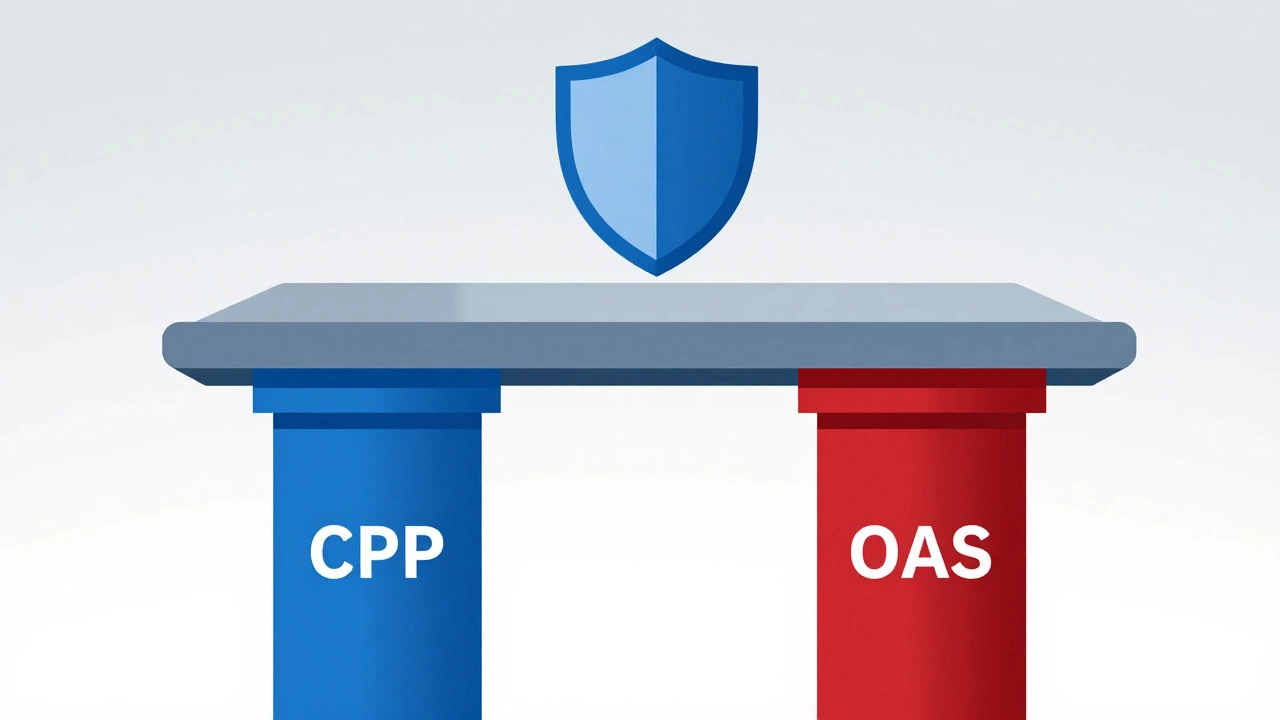
Most Canadians assume that Social Security is the same as what Americans call it. In reality, our system relies on two main government pillars: the Canada Pension Plan (CPP) and the Old Age Security (OAS). When people ask which is better, they are usually comparing their private or workplace pension against these public benefits. The truth is, neither is inherently "better"; they serve different roles in your financial safety net.
Understanding the Core Difference
To make a smart decision, you need to understand what each stream actually provides. A workplace pension is an employer-sponsored plan that promises a specific monthly income based on your salary and years of service. It is designed to replace a portion of your pre-retirement earnings. On the other hand, CPP and OAS are universal or contribution-based programs that provide a baseline income for all eligible seniors, regardless of whether you had a pension.
The key distinction lies in risk and control. With a defined benefit pension, the employer bears the investment risk. You know exactly how much you will get every month. With CPP and OAS, the government manages the funds, but the amounts are adjusted for inflation and tied to national average earnings. If you have a robust workplace pension, you might not need to rely heavily on CPP. However, if you self-employed or worked in jobs without pensions, CPP becomes your primary replacement for lost income.
Comparing Income Streams: A Practical Look
Let's look at realistic numbers for someone retiring in Toronto in 2026. Suppose you earned $80,000 annually throughout your career. Your CPP contribution would be calculated based on the Year's Maximum Pensionable Earnings (YMPE). For 2026, the YMPE is projected to be around $71,300. This means you contribute 11.9% of your earnings up to that limit. At age 65, this could translate to approximately $1,300 per month before tax.
Now, consider a typical defined benefit pension. If your employer offers a plan that replaces 2% of your final average salary for each year of service, and you worked there for 35 years, you might receive about 70% of your final salary as a pension. That is roughly $4,667 per month. Comparing the two, the pension provides significantly more income than CPP alone. However, if you did not have a pension, CPP would be your only guaranteed government income besides OAS, which is currently around $600-$700 per month for most full-time recipients.
| Income Source | Eligibility | Typical Monthly Amount | Inflation Protection | Tax Treatment |
|---|---|---|---|---|
| CPP | Contributors with valid contributions | $1,000 - $1,400 | Yes (CPI-linked) | Taxable |
| OAS | Citizens/residents 65+ | $600 - $700 | Yes (CPI-linked) | Partially taxable |
| Defined Benefit Pension | Employer-specific | Varies (often $3,000+) | Often yes | Taxable |
| RRSP | All taxpayers | Depends on savings | No (market dependent) | Taxable upon withdrawal |
When a Pension Beats Government Benefits
A workplace pension is generally "better" if it is a defined benefit plan that is well-funded. These plans offer stability. You don't have to worry about market crashes eating into your monthly check. In contrast, if you rely solely on investing your own money in an RRSP or TFSA, your income fluctuates with the stock market. During a recession, your withdrawals might drop significantly, whereas your CPP payment remains steady because it is indexed to inflation.
However, there is a catch. Many older workers find that their pension is frozen or underfunded. If your employer goes bankrupt, a defined benefit pension may be protected by the Pension Adjustment (PA) limits, but it can still face cuts. In such cases, the predictability of CPP and OAS becomes invaluable. They are backed by the federal government, making them one of the safest assets you can hold. So, while a healthy pension pays more, CPP provides the floor that keeps you out of poverty.
Strategic Choices: Opting Out or Delaying
You have more control over these systems than you think. For CPP, you can choose when to start receiving payments. If you begin at age 60, you get a reduced amount (roughly 36% less per year). If you wait until age 70, you get an increased amount (roughly 36% more per year). This is a powerful tool. If you have a large pension, you might delay CPP to boost your total income later in life, especially if you expect to live past 80. Conversely, if you are in poor health or have no other income, starting early at 60 makes sense to secure cash flow sooner.
OAS works differently. You can also defer OAS from age 65 to 70. For every month you delay, your future payment increases by 0.6%. After five years, that’s a 36% boost. This strategy is often used by high-income earners who want to maximize their tax-free or low-tax income streams. Since OAS has a clawback for high incomes (the Old Age Security Recovery Tax), delaying it can sometimes help manage this liability, though the math requires careful planning with a tax advisor.
Tax Implications and Net Income
Gross income isn't everything; what matters is what lands in your bank account after taxes. Both CPP and OAS are considered income for tax purposes. However, OAS has a unique feature: part of it may be non-taxable depending on your province and personal circumstances. In Ontario, where I live, the tax brackets are relatively standard, but the interaction between pension income and CPP/OAS can push you into higher tax brackets if you aren't careful.
If you have a large pension, withdrawing it alongside CPP and OAS can spike your taxable income. To mitigate this, many retirees use a strategy called "income smoothing." This involves withdrawing smaller amounts from registered accounts (like RRIFs) in some years and larger amounts in others, balancing the total income to stay within lower tax brackets. A pension provides a fixed base, while CPP and OAS add another layer. The goal is to keep your marginal tax rate as low as possible, maximizing your net disposable income.

Common Pitfalls to Avoid
One major mistake is assuming that having a pension means you don't need to save. While a pension covers a lot, it rarely covers lifestyle expenses like travel, healthcare extras, or home repairs. Relying 100% on a pension and CPP can leave you vulnerable if costs rise faster than inflation adjustments. Always maintain an emergency fund outside of your retirement accounts.
Another pitfall is ignoring the survivor benefit. CPP and OAS both offer survivor benefits, but the rules differ. If your spouse dies, you might lose their OAS unless you qualify for the spousal allowance. Similarly, your pension might reduce to 60% or 75% for your surviving spouse. Understanding these details ensures that your partner doesn't face a sudden income drop. Finally, don't forget about the Guaranteed Income Supplement (GIS) if your income is very low. This top-up can significantly improve quality of life for those with modest pensions.
Frequently Asked Questions
Is CPP the same as Social Security?
In common parlance, yes, but technically no. In Canada, the equivalent of US Social Security is split between the Canada Pension Plan (CPP) and Old Age Security (OAS). CPP is contribution-based, while OAS is a universal benefit for seniors.
Should I take my pension or lump sum?
This depends on your health, market conditions, and tax bracket. A lump sum gives flexibility but introduces investment risk. An annuity provides guaranteed lifetime income. Generally, if you are risk-averse or have long-term care needs, the annuity is safer. If you have strong investment skills and a shorter life expectancy, the lump sum might yield more.
Can I work while receiving CPP?
Yes, you can work while receiving CPP. However, if you continue working and contributing to CPP, your future benefit amount may increase slightly. There is no penalty for working once you start receiving benefits, unlike some other countries' systems.
How does the OAS clawback affect me?
The Old Age Security Recovery Tax reduces OAS payments for individuals with net income above a certain threshold (around $90,000 in recent years). If your combined income from pensions, CPP, and investments exceeds this limit, you pay back a portion of your OAS. Planning your withdrawal strategies can help minimize this impact.
Which is better for survivors, pension or CPP?
It varies by plan. Most defined benefit pensions offer a survivor pension of 60-75% of the original amount. CPP offers a survivor pension based on the deceased's record, which can be substantial if they had high earnings. OAS has a spousal supplement. You should compare the specific percentages and conditions of your pension plan against the estimated CPP survivor benefit.