
What Does Warren Buffett Invest In? A Guide to His Strategy
 Aug, 30 2026
Buffett's Investment Checklist Simulator
Apply the "Oracle of Omaha's" filters to see if a hypothetical business fits his criteria. Remember: He buys wonderful companies at fair prices, not mediocre ones at cheap prices.
Step 1: The Business Check
Step 2: Price & Management
Analysis Result
Enter values above to receive a Buffett-style verdict.
Moat Visualization:
You might think the Oracle of Omaha spends his days glued to a Bloomberg terminal, chasing the latest tech hype or trying to time the market. But if you look at what Warren Buffett actually buys, you’ll find something surprisingly boring. He doesn’t chase trends. He buys businesses he understands, with durable competitive advantages and honest management. If you’ve ever wondered how he turned $100 into billions, it’s not because he found the next Apple before anyone else. It’s because he held onto Coca-Cola for decades while everyone else was distracted by the dot-com bubble.
The Core Philosophy: Value Investing
Value investing is an investment paradigm that involves buying securities that appear underpriced by some form of fundamental analysis. For Buffett, this isn’t just about finding cheap stocks. It’s about finding great companies at fair prices. He learned this from Benjamin Graham, but he evolved the concept. Early on, he bought "cigar butts"-mediocre companies trading for less than their liquidation value. Later, influenced by Charlie Munger, he shifted to buying wonderful companies at fair prices.
This shift changed everything. Instead of selling after a quick pop in price, he started holding investments for years, sometimes decades. Why? Because compounding works best when you don’t interrupt it. If you buy a company earning $10 per share and it grows earnings at 8% annually, holding it for 30 years lets that growth snowball. Trading it every six months kills that magic.
Berkshire Hathaway’s Stock Portfolio
To understand what Buffett invests in, you have to look at Berkshire Hathaway's public equity portfolio. As of mid-2026, the top holdings remain remarkably consistent. They aren't speculative bets. They are cash-flow machines.
| Company | Sector | Why He Owns It |
|---|---|---|
| Apple Inc. | Technology | Ecosystem lock-in and massive free cash flow generation. |
| Bank of America | Financial Services | Strong domestic franchise and regulatory moat. |
| American Express | Financial Services | Premium brand loyalty and network effects. |
| Coca-Cola Co. | Consumer Staples | Global distribution network and pricing power. |
| Chevron Corp. | Energy | Essential commodity with low-cost production assets. |
Notice anything missing? There’s no Amazon here anymore (he sold most of it). No Microsoft. No Nvidia. This surprises people who assume Buffett hates tech. He doesn’t hate tech; he avoids uncertainty. When he finally bought Apple, he didn’t see it as a tech company. He saw it as a consumer goods company with a sticky ecosystem. That distinction matters. He wasn’t betting on AI chips; he was betting on human behavior.
Beyond Stocks: Wholly Owned Subsidiaries
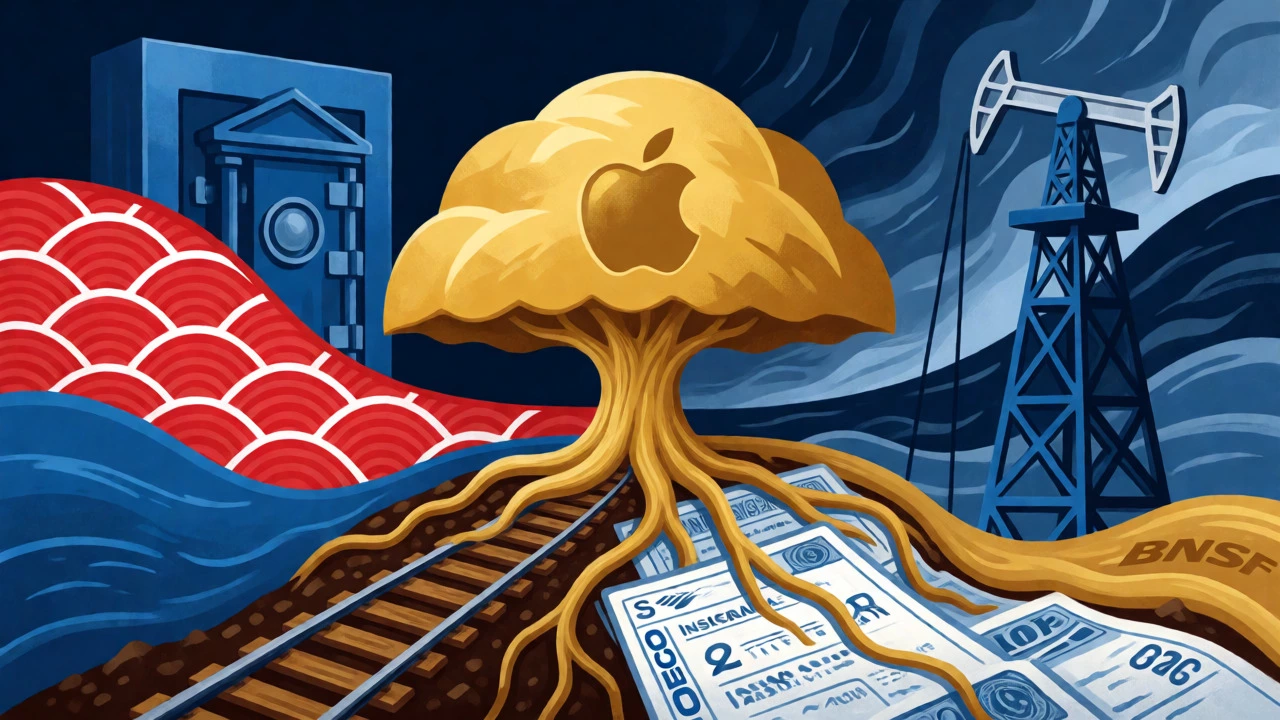
Most articles stop at the stock list, but that’s only half the story. The real engine of Berkshire Hathaway isn’t its stock portfolio-it’s its wholly owned subsidiaries. These are private companies that Buffett controls entirely. Think Geico, BNSF Railway, and See’s Candies.
Why does he prefer owning whole companies over trading shares? Control. When you own 100% of a business, you pick the CEO. You decide where profits go. You don’t worry about quarterly earnings calls or activist investors. BNSF Railway, for example, moves a significant portion of U.S. freight. It’s a capital-intensive business, but it has a wide moat. You can’t easily build another railroad across the country. That physical barrier protects profits from competition.
Geico operates differently. It’s an insurance company, which means it collects premiums upfront (float) and pays claims later. Buffett loves float. It’s essentially interest-free money he can invest elsewhere. If Geico earns 5% on its investments, he keeps all of it. He doesn’t split it with shareholders of other insurers. This structural advantage allows him to take more risk with the float than a typical investor could.
The Role of Cash and Treasury Bills
In recent years, Berkshire Hathaway has accumulated a massive pile of cash. By August 2026, this reserve likely exceeds hundreds of billions of dollars. Many critics call this lazy. They say he’s missing out on returns. But Buffett views cash as an option. It’s the ability to buy when others are panicking.
During the 2008 financial crisis, while everyone else was selling, Buffett had cash. He invested $5 billion in Goldman Sachs preferred stock with a 10% dividend. He made billions almost immediately. Today, with short-term U.S. Treasury bills yielding decent rates, he’s happy to park cash there. It’s safe, liquid, and generates yield without taking equity risk. This patience is rare. Most retail investors feel compelled to be fully invested all the time. Buffett knows that waiting is part of the job.

How to Apply Buffett’s Rules to Your Portfolio
You don’t need billions to use these strategies. You just need discipline. Here’s how to translate Buffett’s approach for a regular investor:
- Circle of Competence: Only invest in businesses you understand. If you work in healthcare, you might spot trends in pharmaceutical companies faster than a banker. Stick to what you know.
- Margin of Safety: Never pay full price. If you calculate a company is worth $100, try to buy it at $70 or $80. This buffer protects you if your analysis is wrong.
- Long-Term Horizon: If you wouldn’t hold a stock for ten years, don’t hold it for ten minutes. Ignore daily noise. Focus on annual reports.
- Ignore Macro Predictions: Buffett doesn’t care if the Fed raises rates tomorrow. He cares if the company has pricing power. Can they raise prices without losing customers? If yes, inflation won’t hurt them.
Consider a local example. Imagine you’re looking at two coffee shops in Toronto. One is a trendy startup with high debt and unproven demand. The other is a franchise with steady traffic, loyal customers, and a manager who has been there for fifteen years. Buffett would buy the franchise every time. It’s not exciting, but it’s predictable. And predictability beats excitement in investing.
Common Misconceptions About Buffett’s Style
People often misinterpret Buffett. They think he’s a genius who picks winners effortlessly. In reality, he makes mistakes too. He famously avoided airlines for years, then bought Delta and lost money during the pandemic. He also missed the early rise of Amazon. His edge isn’t perfection; it’s consistency.
Another myth is that he never touches bonds. While he prefers equities, he uses fixed income strategically. When yields are high, he buys Treasuries. When yields are near zero, he avoids them. It’s opportunistic, not ideological. Also, people assume he avoids international markets. He does invest globally, particularly in Japan recently, buying stakes in major trading houses like Mitsubishi. He looks for undervalued assets wherever they exist, regardless of geography.
Finally, remember that Buffett’s success is partly due to scale. He can move markets with a single trade. You can’t. But you can mimic his mindset. Don’t try to beat the market every month. Try to avoid big losses. Compound modest gains over time. That’s the boring path to wealth, and it’s the one that actually works.
Does Warren Buffett invest in cryptocurrency?
No, Warren Buffett has consistently expressed skepticism toward cryptocurrencies like Bitcoin. He famously called Bitcoin a "rat poison squared," arguing that it produces nothing and has no intrinsic value based on cash flows. Unlike stocks, which represent ownership in productive businesses, crypto relies on speculation about future buyer demand. Buffett prefers assets that generate dividends or earnings.
What is the "Circle of Competence"?
The Circle of Competence refers to the specific industries or types of businesses an investor understands well enough to evaluate accurately. Buffett advises staying within this circle. If you don’t understand how a biotech firm develops drugs, don’t invest in it just because the stock is rising. Knowing what you don’t know is as important as knowing what you do know.
Why does Buffett hold so much cash?
Buffett holds large amounts of cash and short-term Treasury bills to maintain liquidity. This allows him to act quickly when market opportunities arise, such as during economic downturns when asset prices drop. He views cash as an option to buy high-quality assets at discounted prices later, rather than forcing himself to invest in overvalued markets.
Can I copy Buffett’s exact portfolio?
You can replicate his top holdings using ETFs or individual stocks, but timing matters. Buffett buys when valuations are attractive, which may differ from current market conditions. Additionally, his portfolio includes private companies you can’t buy directly. Copying his public stock picks requires understanding why he bought them, not just following the ticker symbol blindly.
What sectors does Buffett avoid?
Buffett tends to avoid sectors with rapid technological obsolescence, heavy debt loads, or unpredictable regulatory environments. Historically, he stayed away from tech for a long time until he understood Apple’s consumer stickiness. He also generally avoids startups with no proven profitability, preferring established companies with consistent free cash flow and durable competitive advantages.