
What Is the Best Thing to Invest Right Now in 2025?
 Dec, 1 2025
2025 Portfolio Allocation Calculator
Calculate how your investment would be distributed across the recommended 2025 portfolio mix: 40% dividend stocks, 25% real estate, 20% short-term bonds, 10% gold, and 5% AI infrastructure.
Your Allocation
Enter your investment amount and click "Calculate Allocation" to see your portfolio breakdown.
If you’re sitting on cash right now and wondering where to put it, you’re not alone. Inflation’s still ticking, interest rates are holding steady, and the stock market feels like a rollercoaster with no map. The question isn’t just what to invest-it’s what will actually grow when everything else feels shaky.
Real Estate Isn’t Dead-It’s Just Slower
People said real estate was over after the 2022 crash. They were wrong. It didn’t die. It just paused. In cities like Toronto, Vancouver, and even secondary markets like Hamilton and Kitchener, rental demand is still climbing. More people are renting because they can’t afford to buy, and those who can buy are waiting for prices to drop further. That creates a sweet spot: buy-to-let properties with solid cash flow.Here’s what actually works in 2025: single-family homes in neighborhoods with good schools and public transit. These aren’t luxury flips-they’re modest, well-maintained homes renting for $2,800 to $3,500 a month in the GTA. With mortgage rates around 5.25%, you can still get positive cash flow if you put 20% down and keep repairs under control. The key? Don’t chase appreciation. Chase rent. A property that brings in $3,000 a month with $2,400 in expenses isn’t exciting-but it’s reliable.
And don’t overlook REITs. Publicly traded real estate investment trusts like Canadian Apartment Properties REIT (CAPREIT) or RioCan offer exposure without the headaches of being a landlord. They pay dividends around 5.5% and have been holding up better than most stocks this year.
Dividend Stocks Are Back in Style
Forget tech stocks that promise growth but never pay a dime. In 2025, investors are going back to the basics: companies that pay you to wait. Blue-chip dividend stocks-especially in utilities, telecom, and banks-are offering yields between 4% and 6%. That’s better than most GICs.Look at Enbridge (ENB). It’s been paying dividends since 1997. It increased its payout every year for the last 28 years. Right now, it yields 6.1%. The company owns pipelines that move oil and gas across North America-infrastructure that doesn’t go out of style. Same with BCE (Bell), which has a 6.3% yield and controls Canada’s biggest telecom network. These aren’t get-rich-quick plays. They’re wealth-staying plays.
And here’s the trick: reinvest the dividends. Use a DRIP (Dividend Reinvestment Plan) to automatically buy more shares. Over five years, that small 6% yield compounds into real ownership. A $10,000 investment in ENB with reinvested dividends would be worth over $13,500 today-not counting the cash you’ve already pulled out.
Short-Term Treasury Bills Are the Quiet Winner
If you’re nervous about the market, don’t ignore the boring stuff. U.S. Treasury bills (T-bills) are the safest place to park cash right now. With the Fed holding rates steady, 3-month T-bills are yielding 4.7%. Six-month? Around 4.9%. A year? Just under 5%.You can buy them directly through TreasuryDirect.gov or through your brokerage. No credit risk. No price swings. No fees. And because they’re short-term, you get your money back quickly if rates change. In 2025, this isn’t just a safe haven-it’s a smart tactical move. You’re earning more than you would in a savings account, and you’re ready to jump into something else when better opportunities appear.
Canadians can also buy Canadian government bonds through the Bank of Canada’s bond purchase program. 5-year bonds are yielding 3.8%. Not as high as U.S. T-bills, but tax-advantaged if held in an RRSP.
Gold Isn’t Just for Doomsday Preppers
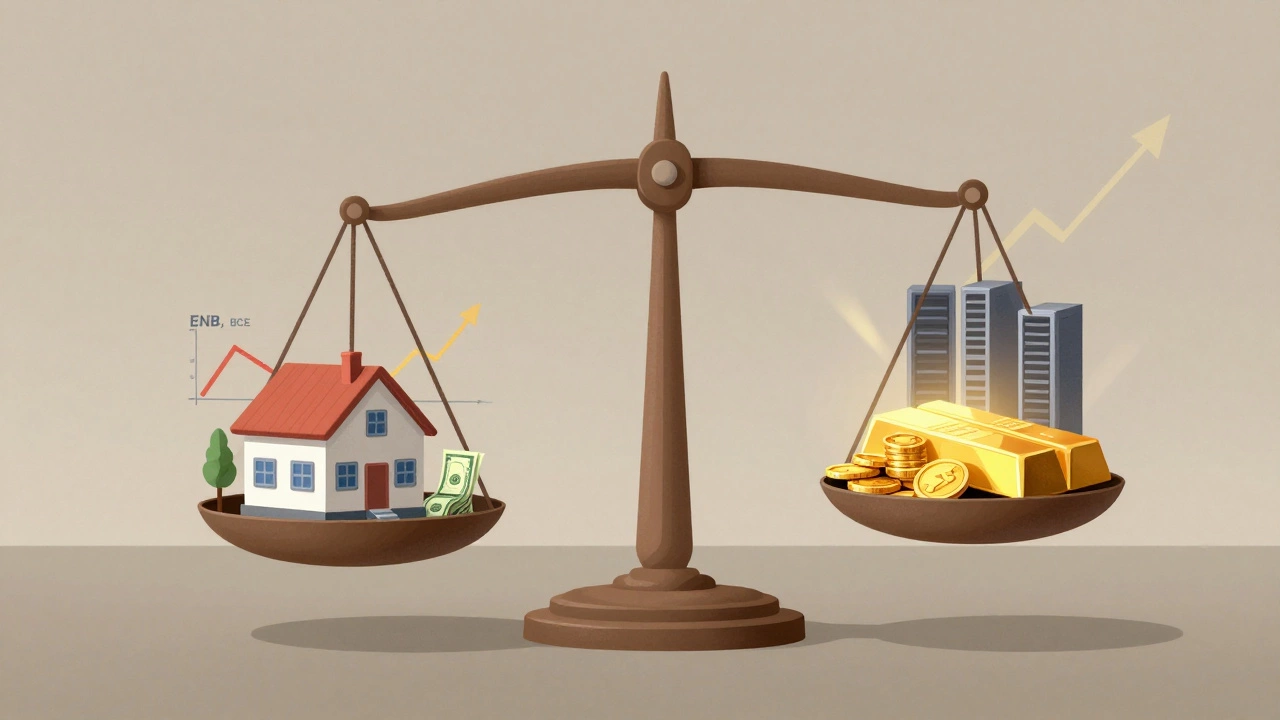
Gold hit $2,400 an ounce in late 2024 and held steady through 2025. Why? Geopolitical tension. Central banks-especially China, Russia, and India-are buying gold at record rates. In the first nine months of 2025, central banks bought over 1,100 metric tons. That’s the most since 1967.Gold doesn’t pay interest. It doesn’t grow. But it holds value when everything else is falling. If inflation spikes again, or if a major bank fails, or if the U.S. dollar weakens, gold moves up. That’s why it’s still in 70% of institutional portfolios.
For most people, the easiest way to own gold is through an ETF like the SPDR Gold Shares (GLD). You buy shares like a stock. No storage. No insurance. No hassle. A $5,000 allocation in gold as part of a diversified portfolio isn’t a bet-it’s insurance.
AI Infrastructure Is the Hidden Growth Engine
You hear about AI stocks like NVIDIA and OpenAI, but the real money isn’t in the flashy names. It’s in the companies building the backbone: data centers, fiber optics, power grids, and cooling systems.Companies like Digital Realty (DLR) and Equinix (EQIX) lease space in massive data centers to tech giants. Demand for AI computing is exploding. One new AI model can require more power than a small city. That means data center space is in short supply-and rents are rising.
These companies are trading at reasonable multiples, paying dividends, and growing revenue by 15%+ year over year. They’re not glamorous. But they’re essential. If AI keeps growing-and it will-these are the companies that will collect the tolls.

What Not to Do Right Now
Don’t chase meme stocks. Don’t buy crypto because someone on TikTok says it’s going to the moon. Don’t throw money into pre-IPO startups. Don’t try to time the market.Here’s what actually happens: people who panic-sell in downturns lose money. People who buy high-risk assets without understanding them lose money. People who think they can beat the market by trading daily lose money.
There’s no magic bullet. The best investment right now isn’t one thing. It’s a mix of safety, income, and growth.
Simple Portfolio for 2025
If you’re starting from scratch, here’s a real-world mix that works for most Canadians:- 40% Dividend stocks (ENB, BCE, TD, RBC)
- 25% Real estate (REITs or rental property)
- 20% U.S. T-bills or short-term government bonds
- 10% Gold (GLD ETF)
- 5% AI infrastructure stocks (DLR, EQIX)
This isn’t flashy. It won’t make you rich overnight. But it will grow steadily, pay you monthly, and survive a recession. You don’t need to be a genius. You just need to be consistent.
Start Small. Stay Steady.
You don’t need $50,000 to begin. Start with $500. Buy $100 in a dividend ETF like XDIV. Put $200 in a 6-month T-bill. Buy $100 in GLD. Reinvest the dividends. Do it again next month. In a year, you’ll have $6,000 invested and a habit that will outlast any market cycle.The best investment right now isn’t a stock, a property, or a coin. It’s your discipline. Show up. Stay patient. Keep learning. That’s the only edge you need.
Is now a good time to buy stocks?
Yes-if you’re buying for the long term and focusing on companies that pay dividends or have strong cash flow. The market isn’t cheap, but it’s not overvalued either. Avoid chasing hot trends. Stick to proven businesses with low debt and steady earnings. Buying slowly over time (dollar-cost averaging) reduces risk.
Should I invest in cryptocurrency in 2025?
Only if you’re prepared to lose it all. Bitcoin and Ethereum have seen big gains, but they’re still extremely volatile. They’re not income-producing assets. They don’t pay dividends. They’re speculative. If you want exposure, limit it to 1-3% of your portfolio. Don’t use borrowed money. Don’t invest money you can’t afford to lose.
What’s better: real estate or stocks?
It depends on your goals. Real estate gives you cash flow and tax benefits but requires hands-on management or a property manager. Stocks are liquid, easy to buy, and offer dividends but can swing wildly in value. Most people do both. A mix of rental income and dividend stocks balances risk and reward.
Are T-bills worth it if I’m not in the U.S.?
Yes. Canadians can easily buy U.S. T-bills through most major brokerages like Questrade or Wealthsimple. The yield is higher than Canadian GICs, and the U.S. government is considered one of the safest borrowers in the world. Currency risk exists, but if you hold them to maturity, you get your principal back in USD. You can also hedge currency if you’re concerned.
How much should I invest right now?
Invest what you can without hurting your emergency fund. Most experts recommend keeping 3-6 months of living expenses in cash first. Then, start investing regularly-even $100 a month. Consistency matters more than the amount. Time in the market beats timing the market.