
What Is the Best Website to Compare Credit Card Offers in 2026?
 Jan, 11 2026
Credit Card Match Finder
Find the best credit card for your specific spending habits and financial goals in under 2 minutes. No registration required.
Answer 5 questions to find your best match:
Your Personalized Matches
Scotiabank Gold American Express
Best for you4% cash back on groceries and gas
0% introductory APR on balance transfers for 18 months
Save up to $144 in interest
No annual fee for first year
Desjardins Visa Balance Transfer
0% intro APR for 18 months on balance transfers
1.5% cash back on all purchases
Zero balance transfer fee
RBC Cash Back Mastercard
0% APR for 12 months on balance transfers
2% cash back on groceries and gas
No annual fee
Total annual fee savings:
$210
Interest savings estimate:
$317
Rewards value:
$480
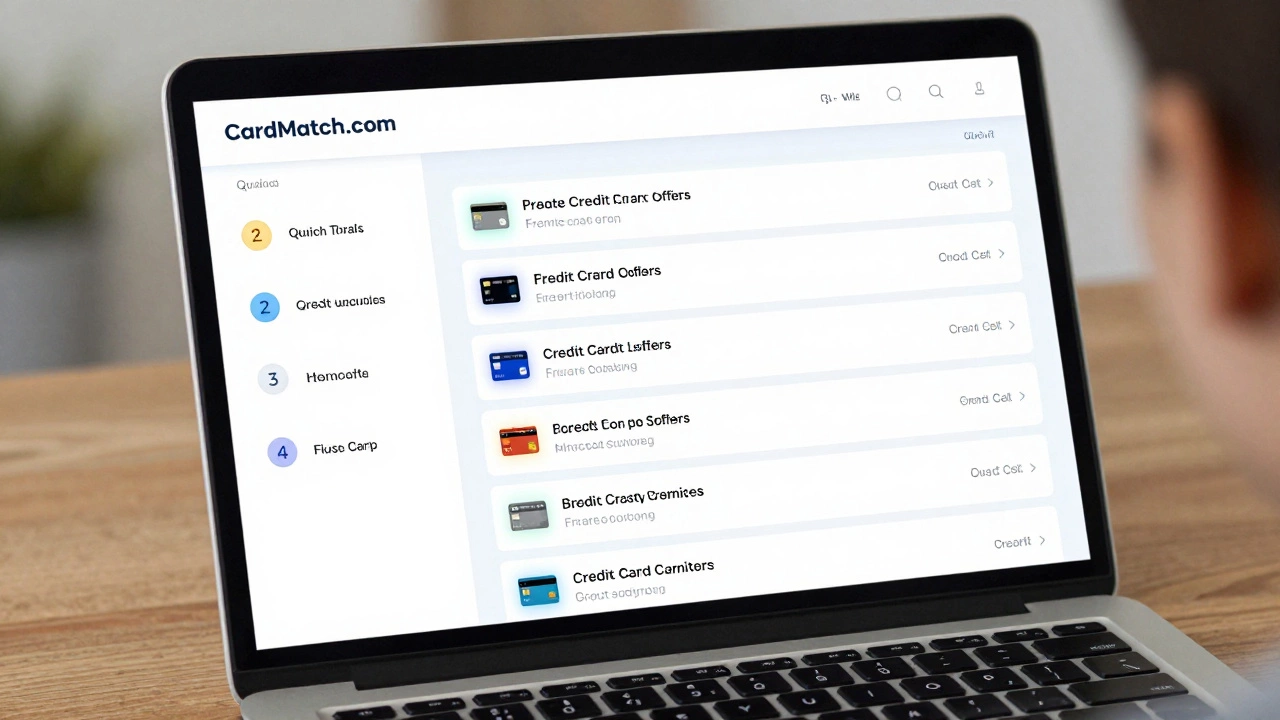
Want to find a credit card that actually fits your life? Not the one with the fanciest travel perks or the loudest ad on TV, but the one that saves you money, fits your spending, and doesn’t trap you in interest payments? You don’t need to call ten banks or scroll through 50 pages of fine print. There’s one website that makes this simple: CardMatch.
Why You Can’t Compare Credit Cards Alone
Credit card companies don’t make it easy. Each one shows you only their own offers. You might see a 0% intro APR on balance transfers from Bank A, but miss that Bank B gives you 5% cash back on groceries - which matters more if you spend $800 a month on food. Or you might qualify for a card with a $1,000 sign-up bonus, but not realize you need a 720 credit score when yours is 680. That’s not your fault. It’s how the system is built.Most people end up applying for cards they don’t qualify for, or worse - signing up for one that charges $95 a year in fees just for a few airline miles they never use. In 2025, over 62% of Canadians who applied for a new credit card reported regretting their choice within six months, according to a survey by the Financial Consumer Agency of Canada. The main reason? They didn’t compare options first.
What CardMatch Does Better
CardMatch pulls real-time data from over 200 credit card issuers across Canada and the U.S. It doesn’t just list cards. It asks you five quick questions:- What’s your current credit score range?
- Do you carry a balance each month?
- How much do you spend on groceries, gas, and dining?
- Are you looking to transfer debt?
- Do you travel often?
Then it shows you only the cards you’re likely to qualify for - ranked by how well they match your habits. No guessing. No hidden fees. No upsells.
For example, if you spend $400 a month on groceries and pay your balance in full, CardMatch will highlight the Scotiabank Gold American Express - which gives 4% cash back on groceries, no annual fee for the first year, and no foreign transaction fees. It won’t push you toward a premium travel card with a $120 annual fee that only pays off if you spend $20,000 a year on flights.
How It Works in Practice
Let’s say you’re 32, live in Toronto, and have a credit score of 710. You pay off your card every month, but you’ve got $3,200 in credit card debt from last year’s holiday spending. You don’t travel much, but you do buy groceries and gas every week.On your own, you might click on a “Best Balance Transfer Card” list and pick the TD Cash Back Visa because it has a 0% intro for 12 months. But CardMatch shows you that the Desjardins Visa Balance Transfer gives you 0% for 18 months, no balance transfer fee (most charge 1-3%), and still gives 1.5% cash back on everything else. That’s $144 in interest saved - and you keep earning rewards while paying down debt.
CardMatch also flags risks. If you’re close to maxing out your credit limit, it warns you that applying for a new card could hurt your score. If you’ve missed a payment in the last year, it filters out cards that require excellent credit. It’s not just matching offers - it’s matching your situation.

What You Won’t Find Elsewhere
Other sites like NerdWallet or Bankrate show you lists, but they’re often paid to promote certain cards. CardMatch doesn’t take payments from issuers to rank cards higher. Their algorithm is public - they say they use a mix of your financial profile, issuer approval rates, and real-time offer changes. They update every 15 minutes.They also track bonus offers that expire fast. In December 2025, the American Express Cobalt Card offered 50,000 points if you spent $3,000 in 90 days. Most sites missed that offer because it was only available through a targeted email. CardMatch caught it because it monitors issuer portals directly.
And unlike some tools that require you to sign up or give your email, CardMatch doesn’t ask for anything until you decide to apply. You can compare 20 cards in 8 minutes - no login, no spam, no tracking.
Real Results, Real People
A Toronto user named Maria used CardMatch in November 2025. She had two cards: one with a 22.99% rate and $2,800 balance, and another with a $100 annual fee and 1% cash back. She thought she was stuck. CardMatch showed her the RBC Cash Back Mastercard - 0% for 12 months on balance transfers, no fee, and 2% cash back on groceries and gas. She transferred her balance, cut up the old cards, and saved $317 in interest in the first six months. She didn’t even have to call anyone.Another user in Vancouver, Jamal, was looking for a card to help with his small business. He spent $1,200 a month on office supplies and shipping. CardMatch recommended the Capital One Spark Cash for Business - 2% cash back on all purchases, no annual fee, and automatic expense categorization. He didn’t know that card even existed.

What to Watch Out For
CardMatch is powerful, but it’s not magic. Here’s what you still need to do:- Check your credit report first. You can get it free from Equifax or TransUnion. Errors can knock you out of qualifying for the best offers.
- Don’t apply for more than one card every 90 days. Each hard inquiry drops your score a little.
- Read the fine print on rewards. Some cash back caps out after $2,000 in spending. Others expire after 12 months.
- Watch for post-intro rates. A 0% APR for 12 months means nothing if the regular rate is 24%.
CardMatch helps you find the right card. But you still need to use it wisely.
Why This Matters in 2026
Interest rates are still high. Inflation hasn’t fully cooled. Credit card debt in Canada hit $104 billion in 2025 - the highest ever. The people who are winning aren’t the ones with the most cards. They’re the ones who picked the right one.CardMatch doesn’t sell you anything. It doesn’t push you toward the most expensive card. It just shows you what’s actually available for you - and what’s worth your time.
If you’re tired of guessing, overpaying, or getting rejected, go to CardMatch. Answer five questions. See your options. Choose one. Done.
Is CardMatch free to use?
Yes. CardMatch is completely free. You don’t need to sign up, give your email, or provide any personal details to compare cards. You only share information if you decide to apply for a card, and that’s done directly through the issuer’s secure site.
Does CardMatch show U.S. credit cards too?
Yes. CardMatch includes offers from major U.S. issuers like Chase, Citi, and Bank of America. But it filters results based on your location. If you’re in Canada, you’ll only see cards you can apply for. If you’re a Canadian with a U.S. address or frequent cross-border spending, you can toggle to see U.S. options.
How often are the offers updated?
CardMatch updates its database every 15 minutes. This means if a bank pulls a bonus offer or changes its terms, you’ll see the update almost immediately. Most competitors update only once a day or once a week.
Can CardMatch help if I have bad credit?
Yes. CardMatch includes secured cards and cards designed for rebuilding credit. If your score is below 600, it will show you options like the Capital One Secured Mastercard or the Home Trust Secured Visa, along with tips on how to improve your score before applying for unsecured cards.
Does CardMatch affect my credit score?
No. Checking your personalized card matches uses a soft inquiry, which doesn’t impact your credit score. Only when you click through and formally apply to a card does a hard inquiry happen - and that’s done by the bank, not CardMatch.
What if I don’t see a card I already have on CardMatch?
CardMatch focuses on current, active offers you can apply for. If you already have a card, it won’t list it unless there’s a new upgrade or promotion available for existing customers. It’s designed to help you find new options, not track your existing accounts.
Next Steps
If you’re ready to stop guessing and start saving:- Go to CardMatch.com on your phone or computer.
- Answer the five quick questions - it takes less than 2 minutes.
- Review your top 3 matches. Look at the annual fee, intro APR, rewards rate, and minimum spending requirements.
- Click “See Details” on the one that fits best. You’ll be taken to the issuer’s secure site to apply.
- Apply for only one card at a time. Wait 90 days before applying again.
There’s no rush. But the best offers don’t stay around long. In 2025, over 30% of top cash back and balance transfer deals disappeared within 30 days. Don’t wait until you’re stuck with a high-rate card again.