
What Is the Minimum Credit Score for an Equity Loan? (2026 Guide)
 Aug, 13 2026
Equity Loan Eligibility Checker
Your Details
Enter your details and click "Check Eligibility" to see if you qualify for an equity loan.
You’ve spent decades paying down your mortgage. Now, you want to tap into that wealth for retirement living, home improvements, or helping family. But before you sign anything, a nagging question pops up: does my credit history still matter? Specifically, what is the minimum credit score for an equity loan?
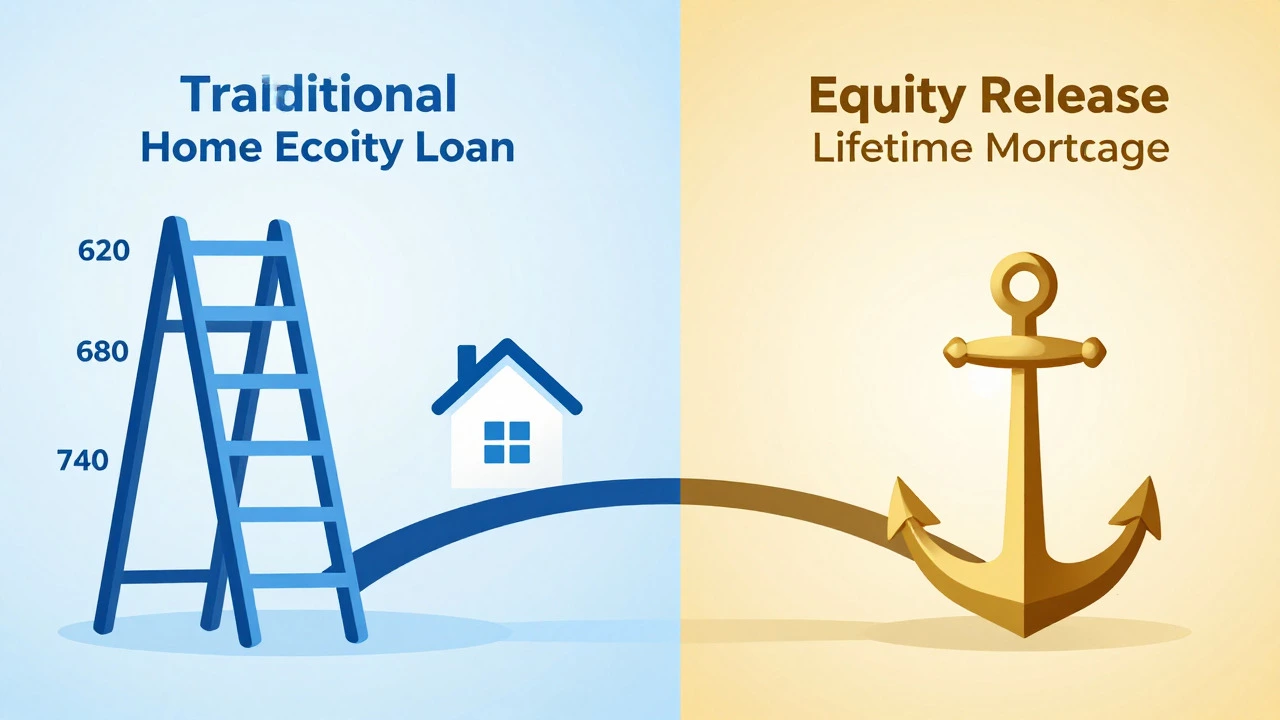
The short answer is complicated because "equity loan" can mean two very different things depending on where you live and what product you’re buying. If you are looking at a traditional Home Equity Loan in North America, lenders usually demand a FICO score of at least 620. However, if you are exploring Equity Release products like Lifetime Mortgages common in the UK or similar reverse mortgage structures elsewhere, credit scores often play a surprisingly small role.
Let’s break down exactly how lenders view your credit file when you’re trying to unlock cash from your property, what numbers actually trigger approval, and what happens if your score isn’t perfect.
Understanding the Two Types of Equity Loans
To get the right number, we first need to clarify which financial product you are talking about. The term "equity loan" is often used loosely by consumers, but in the finance world, it splits into two distinct categories with different rules.
Home Equity Loan is a lump-sum loan secured by the equity in your home, requiring regular monthly payments of principal and interest. This works like a second mortgage. You borrow $50,000, and you pay it back over 10, 15, or 30 years. Because you have a repayment obligation, lenders care deeply about your ability to pay. Your credit score is a primary gatekeeper here.
Equity Release is a financial arrangement allowing homeowners over a certain age to access tax-free cash from their property value without making monthly repayments. In the UK, this is often called a Lifetime Mortgage. In the US, it’s known as a Reverse Mortgage. Since there are no monthly payments, your income and credit score matter much less. Instead, the lender looks at the property value and your age.
If you are in Canada, the landscape is slightly different again. We don’t have widespread "Lifetime Mortgages" like the UK. Most Canadians looking to access equity use a Home Equity Line of Credit (HELOC) or a Cash-Out Refinance. For these, credit scores are critical.
Minimum Credit Scores for Traditional Home Equity Loans
If you are applying for a standard Home Equity Loan or HELOC where you must make monthly payments, lenders use your credit score to predict risk. Here is the general hierarchy used by major banks and credit unions in 2026:
- FICO Score 740+: You will qualify for the best interest rates. Lenders see you as low-risk.
- FICO Score 680-739: Good standing. You’ll likely get approved with competitive rates.
- FICO Score 620-679: Fair credit. Approval is possible, but expect higher interest rates and stricter debt-to-income (DTI) requirements.
- FICO Score Below 620: Very difficult. Most conventional lenders will deny your application unless you have significant compensating factors, like a massive amount of equity (low Loan-to-Value ratio).
So, the hard floor for most conventional lenders is a 620 FICO score. Some aggressive private lenders might go lower, down to 580, but the costs will be steep. They charge more because they assume you are more likely to default.
It’s also worth noting that lenders don’t just look at the number. They look at recent behavior. Did you miss a payment last month? Do you have maxed-out credit cards? Even with a 650 score, recent delinquencies can kill an equity loan application.
Does Credit Score Matter for Equity Release (Reverse Mortgages)?
This is where the story changes dramatically. If you are older-typically 55 or 62+, depending on the country-and you want an Equity Release product where you don’t make monthly payments, your credit score is secondary.
For Lifetime Mortgages in the UK, regulated by the Equity Release Council, there is no strict minimum credit score. Why? Because you aren’t repaying the loan monthly. The debt is repaid when you die or move into long-term care. The lender’s risk is tied to the property value, not your monthly cash flow.
However, "no minimum" doesn’t mean "no check." Lenders will still pull your credit report to ensure there are no outstanding County Court Judgments (CCJs) or bankruptcies that could complicate the sale of the property later. If you have a clean slate regarding major defaults, a poor credit score won’t stop you from getting a Lifetime Mortgage.
In the United States, for Home Equity Conversion Mortgages (HECMs) insured by the FHA, there is technically no minimum credit score requirement either. The government focuses on whether you can afford to keep paying property taxes and homeowners insurance. If you owe back taxes or have lapsed insurance due to non-payment, you’ll be denied. But your FICO score itself? It’s largely irrelevant.
Other Factors That Matter More Than Your Score
If your credit score is shaky, don’t panic yet. When unlocking home equity, other metrics often outweigh your three-digit number. Lenders look at the big picture of your financial health.
| Factor | Home Equity Loan (Repayment Required) | Equity Release / Reverse Mortgage (No Monthly Payments) |
|---|---|---|
| Credit Score Importance | High (Min ~620) | Low (Check for major defaults only) |
| Loan-to-Value (LTV) | Max 80-85% total equity usage | Varies by age; typically 20-60% of value |
| Debt-to-Income (DTI) | Must be under 43-50% | Not applicable (no monthly payments) |
| Property Type | Must be primary residence, good condition | Must be primary residence, good condition |
| Age Requirement | None | Usually 55+ or 62+ |
Loan-to-Value Ratio (LTV): This is the percentage of your home’s value you already owe versus what it’s worth. If your home is worth $500,000 and you owe $100,000, you have $400,000 in equity. A high equity position can sometimes offset a mediocre credit score. Lenders love collateral.
Property Condition: The house must be livable and structurally sound. If your roof is leaking or the foundation is cracked, the appraiser will flag it. No equity product will fund a money pit. The property is the security for the loan.
Ongoing Costs: For reverse mortgages and equity release, you must prove you can pay property taxes and insurance. If you have a history of falling behind on these specific bills, you’ll be rejected regardless of your credit score.
What If Your Credit Score Is Too Low?
If you need cash from your home but your credit score is below 620, or you have recent bankruptcies, you still have options. You just need to adjust your strategy.
- Wait and Rebuild: If it’s not an emergency, spend 6-12 months improving your score. Pay down revolving credit, dispute errors on your report, and become an authorized user on a family member’s card. A 20-point boost can open doors.
- Consider a Co-Signer: For traditional home equity loans, adding a spouse or adult child with excellent credit as a co-borrower can help you qualify. Their strong profile offsets your weak one.
- Look at Private Lenders: Hard money lenders or private equity firms may offer loans based purely on asset value. These are expensive and short-term, so use them only for bridging gaps, not long-term financing.
- Switch to Equity Release: If you meet the age criteria, shifting focus to a Lifetime Mortgage or Reverse Mortgage bypasses the credit score hurdle entirely. Focus instead on ensuring your property taxes are current.

Common Pitfalls to Avoid
When chasing equity, it’s easy to make mistakes that cost you thousands. Avoid these common traps:
- Applying to Multiple Lenders at Once: Each hard inquiry can ding your score by a few points. While multiple inquiries within a 14-45 day window count as one for scoring models, it’s better to pre-qualify softly first.
- Ignoring Closing Costs: Equity loans and releases come with fees. Appraisals, legal fees, origination charges, and broker commissions can add up to 2-5% of the loan amount. Factor this into your net proceeds.
- Assuming All Equity Is Accessible: You rarely get 100% of your equity. Lenders cap the total LTV. If you owe 80% of your home’s value, you might only be able to borrow another 5-10%, not the full remaining 20%.
Final Thoughts on Accessing Home Wealth
Your credit score is a key, but it’s not the only lock on the door to your home’s equity. For traditional loans, aim for a 620+ FICO score to stay in the game. For age-based equity release products, your credit history matters far less than your property’s value and your ability to maintain it.
Before signing any paperwork, run the numbers. Calculate the true cost of borrowing, including interest and fees. And always, always speak to an independent financial advisor who specializes in equity products. They can tell you if a Home Equity Loan, a HELOC, or an Equity Release plan is the right fit for your specific situation.
What is the absolute minimum credit score for a home equity loan?
Most conventional lenders require a minimum FICO score of 620 for a home equity loan. Some private lenders may accept scores as low as 580, but interest rates will be significantly higher. Scores above 740 secure the best terms.
Do I need a good credit score for equity release or lifetime mortgages?
Generally, no. Equity Release products like Lifetime Mortgages do not have a strict minimum credit score because there are no monthly repayments. Lenders mainly check for major defaults, bankruptcies, or unpaid judgments that could affect the property title.
Can I get an equity loan with bad credit and no income?
It is very difficult. Traditional home equity loans require proof of income to service the debt. If you have bad credit and no income, your best option might be an Equity Release product (if you are over 55-62), provided you can afford ongoing property taxes and insurance.
How does a low credit score affect my equity loan interest rate?
A lower credit score signals higher risk to lenders. If your score is between 620 and 679, expect to pay a higher interest rate compared to someone with a 740+ score. This difference can amount to thousands of dollars over the life of the loan.
What is the difference between a HELOC and a Home Equity Loan?
A Home Equity Loan gives you a lump sum upfront with fixed monthly payments. A HELOC (Home Equity Line of Credit) works like a credit card, giving you a credit limit you can draw from as needed, with variable interest rates and flexible repayment terms during the draw period.
Does bankruptcy prevent me from getting an equity loan?
Recent bankruptcy makes it very hard to get a traditional home equity loan. Most lenders require a waiting period of 2-4 years after discharge. However, some Equity Release products may still be available if the bankruptcy is resolved and the property title is clear.