
Which Bank Has the Lowest Car Loan Interest Rate in Canada? (2026 Guide)
 Aug, 6 2026
Car Loan Interest Savings Calculator
Loan Details
Buying a car is expensive. The sticker price is just the beginning. What really hurts your wallet over time is the interest you pay on that loan. If you are looking for the absolute lowest number possible, the answer isn't as simple as picking one specific bank. In fact, the "lowest" rate changes depending on who you are, where you live, and how much cash you have ready to put down.
In Canada right now, the landscape of auto financing is shifting. We are seeing a mix of aggressive promotions from big banks and surprisingly competitive offers from smaller lenders. To get the best deal, you need to understand not just which institution has the low number on their website, but which one will actually give *you* that number.
The Big Banks: Convenience vs. Cost
When most people think about getting a car loan, they go to their existing bank. It feels safe. You know the brand. But does it save you money?
The major Canadian banks-Royal Bank of Canada (RBC), TD Canada Trust, Scotiabank, Bank of Montreal (BMO), and Canadian Imperial Bank of Commerce (CIBC)-often advertise rates that look attractive at first glance. However, these advertised rates are usually reserved for customers with perfect credit scores (780+) and high income levels.
If you already bank with one of these institutions, check if they offer a loyalty discount. Some banks reduce your interest rate by 0.5% to 1% if you have direct deposit set up or hold multiple accounts with them. This hidden perk can sometimes make a big bank cheaper than a competitor's headline rate.
However, if you don't have an existing relationship, walking into a branch might result in a higher rate. Why? Because you are a new customer with less data for them to assess risk. They may charge more to compensate for that uncertainty.
Credit Unions: The Secret Weapon for Low Rates
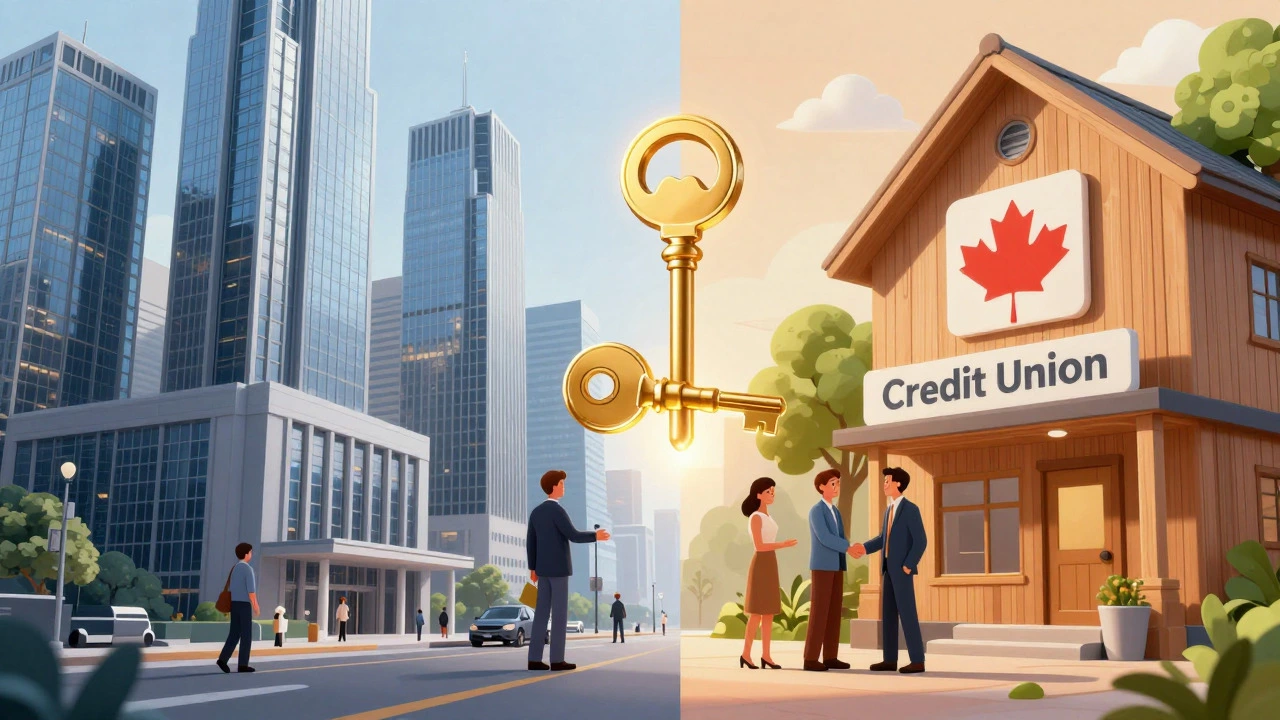
If you want the genuinely lowest interest rates in Canada, you often need to look outside the big five banks. Credit unions like Desjardins, Vancity, Meridian Credit Union, and regional co-ops across Ontario, BC, and Alberta operate differently.
Credit unions are member-owned. They don't have shareholders demanding profits. Instead, they return value to members through lower fees and better rates. In many provinces, credit unions consistently beat big banks on auto loan rates by 0.25% to 0.75%. That difference might sound small, but on a $30,000 loan over five years, saving 0.5% means keeping hundreds of dollars in your pocket.
The catch? You usually need to be a member. Some credit unions are open to anyone in a certain region or industry. Others require membership in a specific association. Check if your local credit union accepts new members. If they do, join immediately before applying. The membership fee is often minimal compared to the interest savings.
Online Lenders and Fintech Disruptors
A newer player in the game is the online-only lender. Companies like Simple Financial, Mogo, and various peer-to-peer lending platforms have entered the auto finance space. These lenders use algorithms to assess risk faster and cheaper than traditional banks.
Because their overhead costs are lower (no physical branches), they can pass some of those savings to you. Online lenders often provide pre-approved quotes without affecting your credit score initially. This allows you to shop around aggressively. You can compare a quote from RBC against one from a local credit union and an online fintech side-by-side.
However, be cautious. Some online lenders target borrowers with weaker credit. While they offer accessibility, their rates can be significantly higher if your credit history has blemishes. For prime borrowers, though, fintechs can offer very competitive fixed rates.
Dealer Financing: Don't Ignore the Source
Here is a counterintuitive tip: sometimes the dealer has the lowest rate. Automakers like Toyota Financial Services, Honda Financial, Ford Credit, and BMW Financial Services want to sell their cars. To move inventory, especially older models or slow-selling trims, they subsidize interest rates.
You might see promotions like "0.9% for 60 months" or "$0 down." These deals are often exclusive to the manufacturer's finance arm. No external bank can match a subsidized rate because the automaker is essentially paying part of the interest cost to get the car out the door.
The trick is to separate the vehicle price negotiation from the financing discussion. First, agree on the price of the car. Then, ask the dealer for their best financing rate. Compare that number to what your bank or credit union offered. If the dealer's subsidized rate is lower, take it. Just make sure there are no hidden fees bundled into the monthly payment.
How to Actually Get the Lowest Rate
Finding the lowest rate is only half the battle. Qualifying for it requires strategy. Here is how to position yourself to get the best possible number:
- Boost Your Credit Score: Lenders rely heavily on your credit score. A score above 740 opens the door to prime rates. Pay off small balances, check your report for errors, and avoid opening new credit lines right before applying.
- Put More Money Down: A larger down payment reduces the loan amount and the lender's risk. Aim for at least 10-20% down. This shows financial stability and often qualifies you for a lower interest tier.
- Shorten the Term: Loans with shorter terms (36 or 48 months) typically have lower interest rates than long-term loans (72 or 84 months). Lenders face less risk when they know they will get their money back sooner. Plus, you build equity faster.
- Get Pre-Approved: Before you visit the dealership, get pre-approved from your bank or credit union. This gives you leverage. You can walk into the dealer knowing exactly what rate you can get elsewhere, forcing them to compete.

Fixed vs. Variable Rates: What Should You Choose?
In the current economic climate, the choice between fixed and variable rates matters. Fixed-rate auto loans lock in your interest rate for the entire term. Your monthly payment never changes. This provides predictability and protection if central bank rates rise.
Variable-rate auto loans start with a lower rate but can fluctuate based on market conditions. If interest rates drop, you pay less. If they rise, your payment increases. Given the volatility in recent years, many Canadians prefer the security of fixed rates, even if the starting number is slightly higher.
| Lender Type | Average Rate Range (Prime) | Pros | Cons |
|---|---|---|---|
| Big Five Banks | 5.99% - 7.99% | Convenience, loyalty discounts | Higher rates for non-customers, strict criteria |
| Credit Unions | 4.99% - 6.99% | Lower rates, personalized service | Membership requirements, fewer locations |
| Manufacturer Finance | 0.9% - 5.99% (Subsidized) | Potentially lowest rates, easy approval | Tied to specific car brands, potential upselling |
| Online Lenders | 5.49% - 8.49% | Fast approval, no branch visits | Less personal support, variable quality |
Common Pitfalls to Avoid
Even with a low interest rate, you can still end up paying too much. Watch out for these traps:
Extended Warranties and Add-ons: Dealers often bundle extended warranties, paint protection, or gap insurance into the loan. These add thousands to your principal balance. You then pay interest on money you didn't need to borrow. Buy these products separately if you want them, or skip them entirely.
Long-Term Loans: A seven-year loan makes monthly payments look affordable, but you pay significantly more in interest over time. You also risk being "upside-down" on your loan, owing more than the car is worth. Stick to five years or less if possible.
Ignoring Total Cost: Focus on the total cost of the loan, not just the monthly payment. A lower monthly payment might mean a longer term and higher total interest. Calculate the total amount you will repay over the life of the loan.
Final Thoughts on Finding Your Best Rate
There is no single bank with the universally lowest car loan interest rate. The best rate for you depends on your credit profile, your location, and your willingness to shop around. Start with your credit union if you are a member. Check your existing bank for loyalty perks. Look at manufacturer promotions for the specific car you want. And always get pre-approved before negotiating.
By taking the time to compare offers and understanding how lenders set their rates, you can save thousands of dollars. Don't just accept the first number you hear. Shop smart, negotiate hard, and drive away with a deal that works for your budget.
What is the average car loan interest rate in Canada in 2026?
As of mid-2026, the average car loan interest rate for borrowers with good credit ranges from 5.5% to 7.5%. Rates vary significantly based on the lender type, loan term, and whether the vehicle is new or used. Subsidized rates from manufacturers can be much lower, sometimes under 2%.
Do credit unions really offer lower rates than banks?
Yes, credit unions often offer lower interest rates than big banks because they are member-owned and non-profit. They return value to members through reduced fees and better borrowing rates. However, you must qualify for membership, which may be restricted by geography or profession.
Should I get my car loan from the dealer or my bank?
It depends. Dealer financing (manufacturer loans) can offer subsidized rates that are hard to beat, especially for new cars. However, your bank or credit union may offer a lower rate if you have a strong relationship with them. Always get pre-approved from your own lender before visiting the dealer to compare options.
Does my credit score affect my car loan interest rate?
Absolutely. Your credit score is the primary factor lenders use to determine your interest rate. Borrowers with scores above 740 typically qualify for the lowest "prime" rates. Those with lower scores may face significantly higher interest rates or even denial of credit.
Is it better to choose a fixed or variable rate for a car loan?
For most borrowers, a fixed rate is safer. It locks in your payment for the life of the loan, protecting you from rising interest rates. Variable rates start lower but can increase, making your budgeting unpredictable. Given recent economic volatility, fixed rates provide peace of mind.
How much should I put down on a car loan?
Financial experts recommend putting down at least 10-20% of the vehicle's purchase price. A larger down payment reduces the loan amount, lowers your monthly payments, and decreases the total interest paid. It also helps prevent you from being upside-down on your loan early in the term.