
Which Crypto Will Reach $1? Realistic Candidates and Why Most Won’t
 Mar, 8 2026
Crypto $1 Realism Calculator
Can This Crypto Reach $1?
Calculate the required market cap using real-world benchmarks
Results
For comparison:
Bitcoin peak: $1.2T | Ethereum peak: $495B | Solana peak: $85B
Why this matters: A $1 price requires a market cap equal to the circulating supply in dollars. Most coins with large supply (10B+) can't reach $1 without becoming the world's largest cryptocurrency.
When you hear someone say, "Which crypto will reach $1?" you’re not just hearing a question-you’re hearing a dream. A $1 coin sounds simple. Easy. Like flipping a switch and waking up richer. But in crypto, dreams don’t turn into dollars just because you want them to. The truth? Most coins will never hit $1. Not because they’re bad, but because the math doesn’t work. And the ones that might? They’re not the ones trending on TikTok.
Why $1 Is a Magic Number
$1 isn’t just a price point. It’s a psychological milestone. When a coin hits $1, it stops feeling like a "penny stock" and starts feeling like real money. People see it as a threshold between speculation and legitimacy. But here’s the catch: market cap matters more than price. A coin at $0.01 with a $10 billion market cap is worth more than a coin at $0.90 with a $500 million cap. Price alone tells you nothing. You need to ask: How many coins are out there? And who’s holding them?
Take Solana (SOL). It trades around $120. But if it had 10 billion tokens in circulation, it’d be trading at $12. That’s still high. Now imagine a coin with 100 billion tokens. To hit $1, it needs a $100 billion market cap. That’s bigger than Ethereum’s peak. That’s not easy. And most coins don’t have the demand, the use case, or the community to get there.
Crypto That Could Hit $1: The Real Contenders
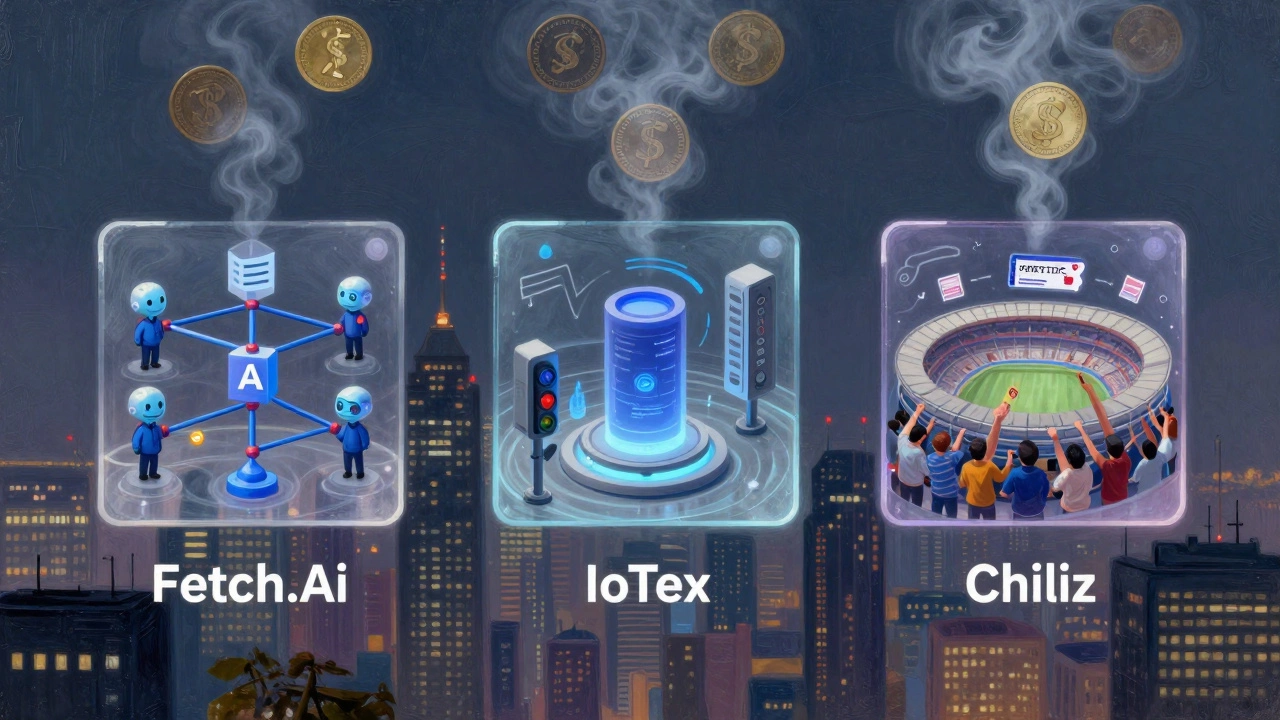
Not all low-priced coins are created equal. Some have real traction. Some have teams, networks, and users. Here are three with a realistic shot-at least in the next 18 months.
- Chiliz (CHZ) - This isn’t a trading coin. It’s a sports fan token. You use CHZ to vote on team decisions, buy NFTs, and access exclusive content from clubs like FC Barcelona and Juventus. Over 5 million users already have wallets tied to it. It trades around $0.08. To hit $1, it needs a 12x increase. That’s tough, but not impossible. If one major league (like the NFL) fully integrates fan tokens, CHZ could surge. It’s already live in 15 countries.
- Fetch.ai (FET) - This one’s quiet but powerful. Fetch.ai builds AI agents that automate tasks on blockchain-like booking travel, managing energy grids, or negotiating supply chains. It’s not flashy, but it’s being used by real companies in logistics and IoT. Its price is around $0.40. To hit $1, it needs a 2.5x jump. That’s doable if AI-driven blockchain adoption picks up in 2026. Major partners include Bosch and IBM’s supply chain division.
- IoTeX (IOTX) - Think IoT meets crypto. IoTeX lets smart devices (like sensors, cameras, even your fridge) earn crypto by sharing data securely. It’s not for traders. It’s for machines. Over 300,000 devices are already on its network. Price is around $0.04. To hit $1, it needs a 25x increase. That’s a stretch, but if smart cities in Europe or Asia start using it for public infrastructure, the demand could spike. It’s already live in Singapore’s pilot smart grid project.
The Coins That Won’t Make It
Every week, someone posts a meme coin with a 10,000x promise. "Buy this, it’ll be $1 by next month!" Here’s why they almost always fail:
- Meme coins - Dogecoin, Shiba Inu, Pepe. They have no utility. No team. No roadmap. Just hype. Dogecoin has a $15 billion market cap and trades at $0.09. To hit $1, it’d need to grow 11x. But it has no new use cases. It’s stuck. Same with Shiba Inu. Its supply is 589 trillion tokens. To hit $1, its market cap would be over $589 trillion. That’s more than the entire global economy.
- Coins with insane supply - Some projects launch with 1 quadrillion tokens. Even if the price rises 100x, it’s still $0.0001. You can’t build value on a supply that’s too big to control. It’s like printing a billion-dollar bill. The value doesn’t exist.
- Coins with no exchange listings - If you can’t buy it on Binance, Coinbase, or Kraken, you’re not investing. You’re gambling. Liquidity matters. Without it, no one can sell. And if no one can sell, the price can’t rise.
What Actually Moves Crypto Prices
It’s not memes. It’s not Elon tweets. It’s three things:
- Adoption - Real people using the tech. Not just buying. Using.
- Partnerships - When a major company integrates a blockchain, prices react. Not because of hype, but because of real demand.
- Regulation - Clear rules help. Uncertainty kills. The U.S. SEC’s stance on crypto in early 2025 created a $300 billion market drop. Clarity in 2026 could unlock trillions.
Look at Polygon. In 2021, it was $0.50. By 2023, it hit $2.50. Why? Because Visa, Starbucks, and Nike started using it for loyalty rewards. Not because it had a dog logo.

How to Spot the Next Crypto
If you’re serious about finding the next coin that could reach $1, here’s what to look for:
- Supply under 10 billion - Too many coins make $1 impossible. Look for projects with under 5 billion circulating.
- Real use case - Does it solve a problem? Not "make money fast," but "reduce fraud in supply chains," "verify vaccine records," or "track carbon credits"?
- Active development - Check GitHub. Are they pushing updates every week? Or has it been silent for 6 months?
- Exchange listings - If it’s not on at least two major exchanges, walk away.
- Community size - Over 50,000 active members on Discord or Telegram? That’s a sign. Under 5,000? Red flag.
The Harsh Reality
Here’s the cold truth: In the next 12 months, maybe two or three altcoins will hit $1. Not 50. Not 100. Two or three. And they won’t be the ones with 10 million followers on Twitter. They’ll be the quiet ones-building, shipping, integrating.
Most people who chase $1 coins lose money. Not because they’re dumb. Because they’re chasing noise. Crypto isn’t a lottery. It’s a marathon. The winners aren’t the ones who bought the cheapest coin. They’re the ones who understood the tech, waited for adoption, and held through the crashes.
If you want to find the next $1 crypto, stop looking at price charts. Start looking at code, partnerships, and real-world usage. That’s where the value is hidden.
Can a crypto with a supply of 100 billion tokens ever reach $1?
Technically, yes-but only if its market cap hits $100 billion. That’s harder than most people think. For comparison, Bitcoin’s market cap peaked at around $1.2 trillion. A coin with 100 billion tokens needs to be worth $1 each, meaning every single token has to be valued at $1. That requires massive adoption, real utility, and sustained demand. Most coins with that kind of supply don’t have the demand. They’re designed to be cheap, not valuable.
Is it better to buy a $0.01 coin or a $10 coin?
It doesn’t matter. What matters is market cap. A $0.01 coin with a $500 million market cap is a much smaller project than a $10 coin with a $10 billion market cap. Buying 10,000 units of a $0.01 coin feels like a big win-but if the project has no real use, it won’t grow. Focus on the total value of the project, not how many coins you can buy for $100.
Why do so many coins fail to reach $1 even with good tech?
Because crypto isn’t just about technology. It’s about trust, liquidity, and timing. Even the best projects can fail if they launch during a bear market, don’t get listed on major exchanges, or can’t attract developers. Many projects have great whitepapers but no users. Without adoption, the price won’t move-no matter how good the code is.
Should I invest in a crypto just because it’s below $1?
No. A low price doesn’t mean a good investment. It often means high risk. Many coins below $1 are either abandoned, have massive supply, or are pump-and-dump schemes. Look for projects with real partnerships, active development, and clear use cases-not just a low price tag.
What’s the safest way to find a crypto that might hit $1?
Start with coins already listed on Coinbase or Binance. Then check their GitHub activity, team background, and real-world use cases. Look for projects that are being used by businesses-not just traders. If a company is integrating the blockchain into its operations, that’s a stronger signal than any price prediction.
If you’re serious about crypto, stop chasing dreams. Start building knowledge. The next $1 coin isn’t hiding in a meme. It’s hiding in the code.