
How Much Social Security Will I Get If I Make $60,000 a Year?
 Feb, 22 2026
CPP Benefit Calculator
Calculate Your CPP Benefits
Estimated Monthly Benefits
Note: These are estimates based on 2026 rates. Actual benefits may vary based on your specific contribution history and future economic conditions.
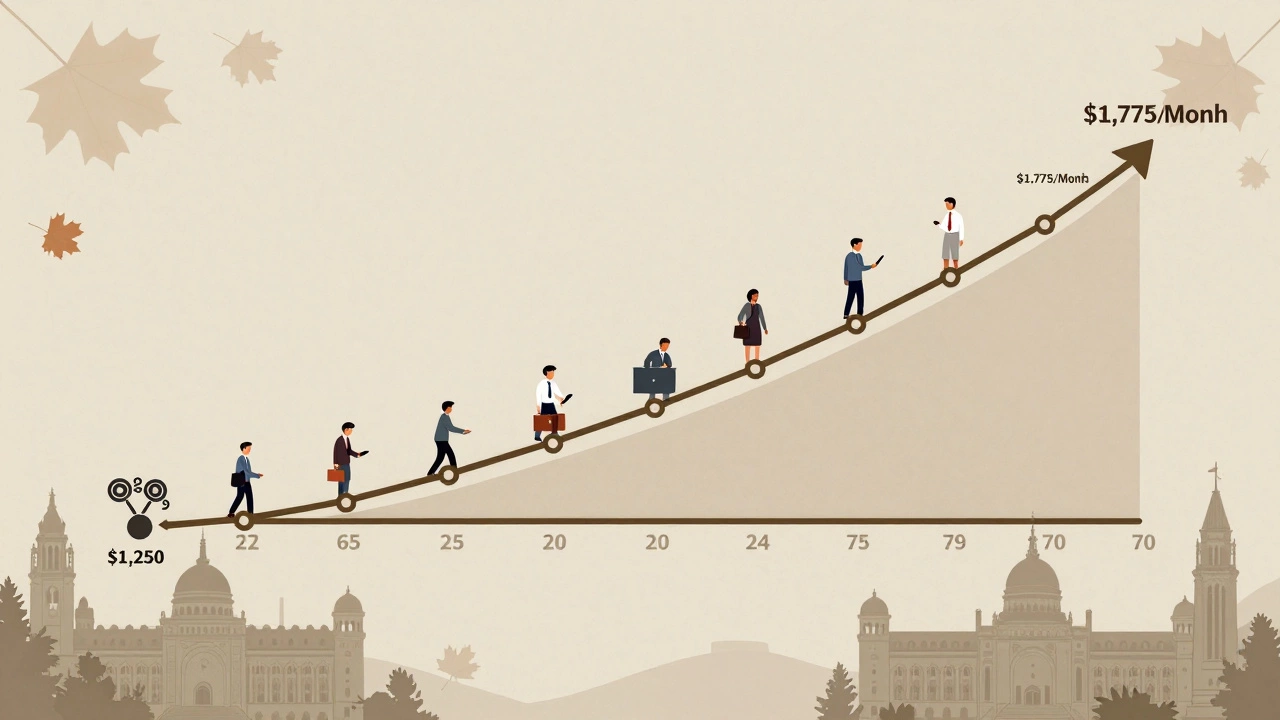
If you make $60,000 a year and are planning for retirement, you’re probably wondering how much you’ll actually get from Canada Pension Plan (CPP) when you stop working. The answer isn’t a simple number-it depends on when you start collecting, how long you’ve contributed, and whether you’ve taken breaks from work. But here’s the straight truth: if you’ve been contributing consistently at $60,000 a year, you can expect about $1,250 per month at age 65. That’s before taxes and before any other income you might have.
How CPP Works: It’s Not a Fixed Benefit
Many people think CPP is like a pension you sign up for and get the same amount no matter what. It’s not. CPP is based on how much you earned and how long you paid into it. The system uses your best 39 years of earnings (out of a possible 47) to calculate your benefit. If you made $60,000 every year since you turned 18, you’re in a strong position. But if you took time off to raise kids, went back to school, or had low-income years, those get dropped out. That’s why someone who made $60,000 for 30 years might get less than someone who made $50,000 for 40 years.
The government uses something called the average industrial wage to set the maximum benefit. In 2026, the maximum CPP payout at age 65 is $1,433.00 per month. To get that full amount, you need to have contributed at the maximum earnings level for 39 years. If you made exactly $60,000 a year, you’re close to the maximum-but not quite there. The CPP contribution ceiling in 2026 is $71,400. So $60,000 is about 84% of the maximum. That means your benefit will be roughly 84% of the full amount.
What Happens If You Start Early or Late?
You can start CPP as early as 60 or as late as 70. But the timing changes everything. If you start at 60, your monthly benefit drops by 0.6% for every month before 65. That’s a 36% cut if you take it at 60. So $1,250 a month at 65 becomes about $800 a month at 60. That might sound tempting if you want to retire early, but you’ll be living on less for longer.
If you wait until 70, you get a 42% boost. That same $1,250 turns into $1,775 a month. That’s more than $21,000 extra per year. For someone who expects to live past 80, waiting pays off. The break-even point is around 81-meaning if you live past that age, you’ll get more total money by waiting. Most people do.
How Your $60,000 Salary Affects Your Contribution
Every year, you and your employer each pay 5.95% of your earnings between $3,500 and $66,600 (the 2026 limits). So if you made $60,000, you paid about $3,300 into CPP. Your employer matched it. That’s $6,600 total going into the system each year. Over 40 years, that adds up to more than $260,000 in contributions. But you don’t get that money back. You get a monthly pension based on how much you earned and how long you paid.
Here’s the math behind the numbers: CPP uses a formula that calculates your average pensionable earnings, then applies a 25% rate. So if your average was $60,000, your base benefit would be 25% of that, or $15,000 a year. But that’s not the whole story. The system also has a dropout provision for low-income years and a ceiling that caps the maximum benefit. That’s why the actual payout is lower than 25% of your salary.
What About Other Income? OAS and GIS
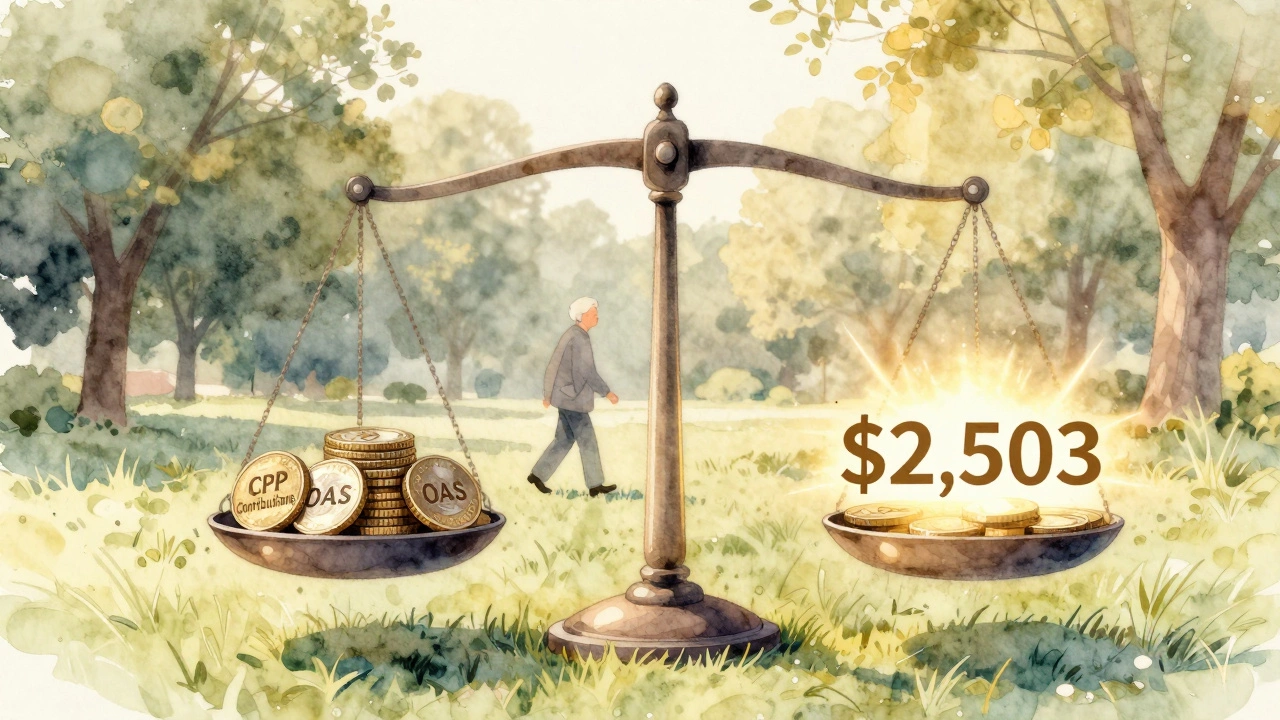
CPP isn’t the only government retirement income. If you’ve lived in Canada for at least 10 years after turning 18, you’ll also get Old Age Security (OAS). In 2026, that’s $728.33 per month, no matter how much you earned. So if you get the full CPP of $1,250 and full OAS of $728, that’s $1,978.33 before taxes.
But here’s the catch: if your net income is over $101,681 in 2026, OAS starts getting clawed back. At $60,000 a year, you’re well below that. So you get the full OAS. You won’t qualify for the Guaranteed Income Supplement (GIS) unless your total income is under $21,500. So if you’re making $60,000 before retirement, you’re not going to get GIS-but you also won’t lose OAS.
Real-Life Examples: What It Looks Like
Let’s say you started working at 22 and retired at 65. You made $60,000 every year. No gaps. No unemployment. No maternity leave. Your CPP would be about $1,250/month. Add OAS: $728. Total: $1,978/month. That’s $23,736 a year. Not rich, but enough to cover basic living costs in most parts of Canada if you own your home and have no debt.
Now imagine you took five years off to raise kids between ages 30 and 35. You made $60,000 before and after. Those five years get dropped out. You’re now using 35 years of $60,000 income instead of 40. Your CPP drops to about $1,100. Total with OAS: $1,828/month. Still solid.
What if you only made $60,000 for 25 years? You started at 25, took 10 years off, then came back. Your benefit drops to around $750. With OAS, you’re at $1,478/month. That’s doable, but tight if you want to travel or help your kids.
What You Can Do to Increase Your Benefit
You can’t go back in time, but you can still improve your outcome:
- Work until 70 if you can. The 42% boost is huge.
- Keep contributing even if you’re self-employed. Every dollar you pay into CPP after 65 adds to your benefit.
- Don’t stop working early just because you think you’re “ready.” Even part-time work helps.
- Check your CPP Statement of Contributions online through Service Canada. It shows your estimated benefit and lets you see which years are being counted.
Common Myths About CPP
- Myth: “I’ll get more if I make more than $60,000.”
Truth: After $71,400, you pay more but don’t get extra benefit. $60,000 is already near the sweet spot. - Myth: “CPP is going broke, so I shouldn’t count on it.”
Truth: CPP is fully funded until at least 2070. The government has made reforms to ensure it lasts. - Myth: “I didn’t earn enough, so I won’t get anything.”
Truth: You need only 3 years of contributions to get a small benefit. Even low-income earners get something.
Final Numbers: What You Can Expect
If you made $60,000 a year for 40 years and retired at 65:
- CPP: $1,250/month
- OAS: $728/month
- Total monthly: $1,978
- Total annual: $23,736
If you retire at 70:
- CPP: $1,775/month
- OAS: $728/month
- Total monthly: $2,503
- Total annual: $30,036
That’s a $6,300 annual difference just from waiting five years. And that’s before any savings, investments, or part-time work.
Can I get CPP if I never worked?
No, you need to have contributed to CPP through employment or self-employment. If you never worked and never paid into the system, you won’t get a CPP benefit. But you might still qualify for Old Age Security (OAS) if you lived in Canada for at least 10 years after turning 18.
Does CPP increase with inflation?
Yes. CPP payments are adjusted every January based on the Consumer Price Index (CPI). This means your benefit keeps up with the cost of living. In 2025, CPP increased by 3.1%. In 2026, it increased by 2.8%. This adjustment happens automatically-you don’t need to apply for it.
What if I moved to another country?
You can still receive CPP if you move abroad, as long as you’ve contributed to the plan. OAS is different-you’ll lose it if you live outside Canada for more than 6 months unless you’ve lived here for at least 20 years after turning 18. Many retirees in the U.S., Spain, or Thailand still get CPP, but not OAS.
Can I collect CPP and still work?
Yes. If you’re between 60 and 65 and collecting CPP, you must keep contributing if you’re still working. Those extra contributions go into a post-retirement benefit, which increases your monthly payment. If you’re over 65 and still working, you can choose to keep contributing-and it will boost your future payments.
Is CPP taxable income?
Yes. Both CPP and OAS are fully taxable. You’ll get a T4A slip each year showing the amount you received. The tax rate depends on your total income. If your only income is CPP and OAS, you’ll pay little or no tax. If you have other income-like a pension or investment earnings-you’ll pay more.
Next Steps: What to Do Now
If you’re making $60,000 today, here’s what to do:
- Log in to your Service Canada account and check your CPP Statement of Contributions.
- Look at how many years are listed and what your estimated benefit is at 65.
- Consider whether you can work a few more years-even part-time-to boost your benefit.
- Plan your retirement income around $20,000-$25,000 a year from CPP and OAS, then fill the rest with savings or investments.
- Don’t assume you’ll get more than $1,300 from CPP. Even if you made $60,000, it’s not a magic number-it’s a calculation.
The key is this: you’re not waiting for a windfall. You’re building a steady, reliable income stream. And with $60,000 in earnings, you’ve already done more than most.