
Is $100k Saved at 30 Good? A Realistic Benchmark for Your Wealth
 May, 11 2026
$100k Savings Allocator & Growth Simulator
Your Financial Profile
Recommended Allocation
$0
0 months coverage$0
Ready to growProjected Growth Over Time
$0
Total Return: 0%
Annual Rate: 0%
Your investment strategy can significantly impact long-term wealth. Even modest annual returns compound powerfully over decades.
There is a strange pressure in your thirties. You scroll through social media, see someone buying a house or posting about their early retirement, and suddenly feel like you’re behind. Then you check your bank account. You have $100,000 saved up. Is that good? The short answer is yes. In fact, it is better than most people think. But the real question isn’t just whether the number looks pretty on a spreadsheet. It is whether that money is working for you.
We often treat savings like a scorecard. If you hit a certain number by age thirty, you win. If you don’t, you fail. That mindset creates anxiety instead of progress. To understand if $100k is actually "good," we need to look at what that money represents, where it lives, and how it fits into your broader financial life. Let’s break down the reality of having six figures in the bank at thirty, without the hype.
The Reality Check: How Does $100k Compare?
First, let’s strip away the noise. Most financial advice online focuses on high earners in tech hubs or coastal cities. They talk about saving $200k or $500k by thirty. Those numbers are impressive, but they are not the norm. For the average person, $100k is a significant milestone.
According to data from the Federal Reserve’s Survey of Consumer Finances, the median net worth for households headed by someone under 35 is often closer to $13,000 to $20,000. Keep in mind, net worth includes assets minus debts. Savings are just one part of that equation. If you have $100k in liquid savings alone, you are already ahead of the vast majority of your peers. You aren’t just "doing okay." You are in the top tier of financial preparedness for your age group.
However, context matters. If you live in Toronto, London, or New York, $100k might feel small because housing costs eat up so much income. In those markets, this amount serves as a powerful down payment or a safety net, but it won’t buy freedom overnight. In smaller cities or rural areas, that same $100k provides a much higher quality of life and faster path to asset ownership. Your location changes the weight of the number, but it doesn’t change the discipline required to get there.
Quality Over Quantity: Where Is the Money Sitting?
Having $100k is great. Keeping it safe is tricky. The biggest mistake people make with a large sum of cash is letting it sit idle. If your entire $100k is in a standard checking account earning 0.01% interest, you are losing money every single day due to inflation. This is known as purchasing power erosion. In a world where inflation hovers around 2-4%, your money buys less each year if it isn’t growing.
You need to ask yourself: Is this money parked in a low-yield environment, or is it working? Here is how different vehicles treat your capital:
- High-Yield Savings Accounts (HYSA): These offer better rates than traditional banks, often between 4% and 5%. They are liquid, meaning you can access the cash instantly for emergencies. This is ideal for your emergency fund portion.
- Bonds and Fixed Income: Government bonds or corporate bonds provide steady interest payments. They are safer than stocks but generally offer lower long-term growth. Good for stability.
- Index Funds and ETFs: These track the broader market. Historically, the stock market returns about 7-10% annually over the long run. This is where wealth compounds significantly. However, it comes with volatility. You must be willing to watch the number drop temporarily without panic-selling.
If your $100k is entirely in cash, you are prioritizing safety over growth. That’s fine for an emergency fund, but bad for retirement. A balanced approach might keep 6 months of expenses in a HYSA and invest the rest in diversified index funds. This way, you stay secure while still capturing market growth.
The Emergency Fund Rule: Do You Need All $100k?
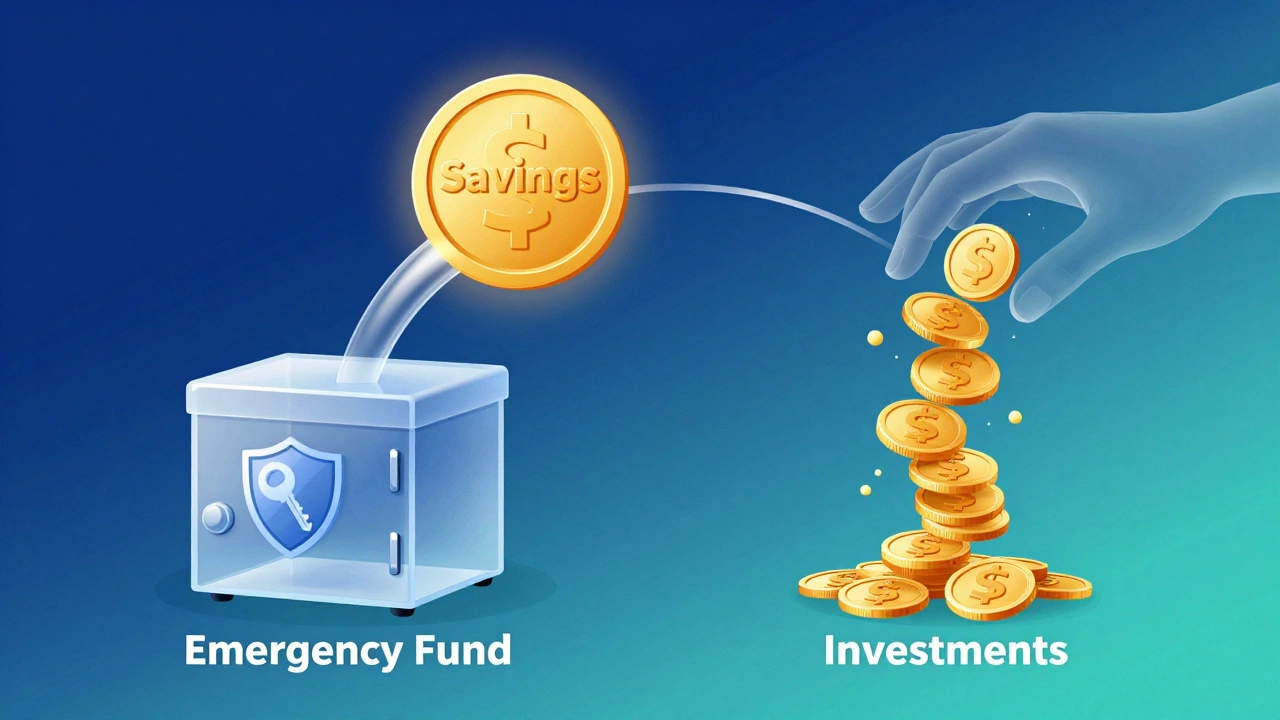
Not all savings are created equal. Some of that $100k should be untouchable. This is your emergency fund. Its job is to protect you from life’s curveballs: car repairs, medical bills, or sudden job loss. Financial experts typically recommend keeping three to six months of living expenses in cash equivalents.
Let’s do some math. If your monthly expenses-rent, food, utilities, insurance-are $4,000, then six months of coverage equals $24,000. That leaves $76,000 of your savings free for other goals. If your expenses are lower, say $2,500 a month, your emergency fund only needs to be $15,000. Suddenly, you have $85,000 available to invest or spend on opportunities.
The key insight here is liquidity. You don’t want to sell investments during a market downturn to pay for a broken water heater. That locks in losses. By segregating your cash into "emergency" and "growth" buckets, you remove emotional decision-making from your finances. You know exactly which dollars are for survival and which are for building wealth.
Debt vs. Savings: The Hidden Anchor
Savings don’t exist in a vacuum. They interact with your debt. If you have $100k saved but also carry $50k in credit card debt at 20% interest, your net financial position is weak. High-interest debt acts as a tax on your wealth. Every dollar you save earns maybe 5%, but every dollar you owe costs you 20%. The math is brutal.
Before investing aggressively, ensure you’ve tackled high-interest debt. This includes credit cards, payday loans, and personal loans with rates above 7-8%. Once those are gone, your $100k becomes pure equity. You own it outright. No lender has a claim on it. This clarity allows you to plan for larger goals like home ownership or starting a business without the drag of monthly interest payments.
Low-interest debt, such as student loans or mortgages with fixed rates below 5%, is different. You don’t necessarily need to pay those off immediately if your investments can outperform the interest rate. In this case, keeping the debt and investing the $100k might make more sense mathematically. It’s a trade-off between security and growth.
| Scenario | Debt Type | Interest Rate | Action |
|---|---|---|---|
| Credit Card Balance | High-Interest Unsecured | 19-25% | Pay off immediately with savings |
| Student Loan | Federal/Fixed Low-Rate | 3-6% | Keep paying minimum; invest surplus |
| Mortgage | Secured Long-Term | 4-7% | Pay as scheduled; invest extra funds |
Opportunity Cost: What Else Could You Buy?
Saving $100k requires sacrifice. You likely skipped vacations, bought used cars, or cooked at home more often. Now that you have the pile, you face a new choice: hoard it or deploy it? Holding too much cash for too long can lead to "opportunity cost." This is the benefit you miss out on when you choose one option over another.
Consider these common uses for a $100k lump sum at age thirty:
- Home Down Payment: In many markets, $100k covers 20% of a $500k home. This avoids private mortgage insurance (PMI) and secures a place to build equity. Real estate historically appreciates, though it is illiquid-you can’t tap into it quickly.
- Education or Skills: Investing in yourself yields high returns. A certification, coding bootcamp, or MBA could double your salary. If your income jumps from $60k to $120k, that $100k investment paid for itself in two years.
- Starting a Business: Entrepreneurship is risky, but $100k provides a runway. It covers initial setup costs and allows you to work for six months without salary. This reduces the pressure to quit too early.
- Retirement Acceleration: Putting $100k into a Roth IRA or 401(k) now means decades of compound interest. Thanks to the power of compounding, that money could grow to $500k or more by the time you retire, assuming average market returns.
There is no single right answer. It depends on your career stage, risk tolerance, and life goals. The danger is leaving the money stagnant while life moves forward. Ask yourself: What problem does this money solve for me right now?

Psychological Factors: The Confidence Boost
Money isn’t just math. It’s psychology. Having $100k saved gives you something called "financial slack." This is the ability to say no. No to a toxic boss who demands overtime without pay. No to a relationship that drains your resources. No to staying in a job you hate just because you’re scared of being broke.
This confidence changes your behavior. You negotiate salaries better because you know you can survive if the deal falls through. You take calculated risks because you have a safety net. People without savings often make desperate decisions-taking predatory loans or accepting poor terms-because they lack options. Your $100k expands your choices. That freedom is priceless, even if it doesn’t show up on a balance sheet.
It also reduces stress. Studies consistently link financial insecurity to poor health outcomes, including anxiety and depression. Knowing you have a buffer improves sleep, relationships, and mental clarity. You stop worrying about the next bill and start thinking about the next decade. That shift in perspective is arguably the greatest return on your savings.
Next Steps: Protecting and Growing Your Wealth
So, is $100k at 30 good? Yes. It is a strong foundation. But it is not a finish line. It is a launchpad. To make sure this number continues to serve you, follow these practical steps:
- Audit Your Cash Flow: Track every dollar coming in and going out for one month. Identify leaks. Automate savings so you pay yourself first.
- Diversify Investments: Don’t put all eggs in one basket. Use a mix of stocks, bonds, and cash. Rebalance annually to maintain your target risk level.
- Increase Income: Savings cap out eventually. Income growth does not. Focus on skills that raise your earning potential. Side hustles help, but career advancement usually wins long-term.
- Review Insurance: One major illness or accident can wipe out $100k fast. Ensure you have adequate health, disability, and life insurance. Protect the asset before you try to grow it further.
- Set Specific Goals: Vague goals like "get rich" don’t work. Set targets: "$50k for house down payment by 32" or "$200k total net worth by 35." Write them down and review quarterly.
Your thirties are a critical decade for wealth building. Compound interest works best when given time. Starting with $100k puts you in a fantastic position. Stay disciplined, avoid lifestyle creep (spending more just because you earn more), and keep learning. The goal isn’t just to have a number. It’s to build a life where money supports your values, not controls them.
Is $100k enough to retire at 30?
For most people, no. Retiring at 30 usually requires a much larger portfolio, often $1-2 million, depending on your lifestyle. The "4% rule" suggests you need 25 times your annual expenses to retire safely. If you spend $40k a year, you’d need $1 million. $100k might support a very frugal lifestyle for a few years, but inflation and unexpected costs will deplete it quickly. Treat this money as a seed for future growth, not a retirement fund yet.
Should I keep $100k in a savings account?
Only if it is your emergency fund. Keeping all $100k in a savings account exposes you to inflation risk. While high-yield savings accounts offer decent returns (4-5%), they rarely beat the long-term growth of the stock market (7-10%). Split your money: keep 3-6 months of expenses in cash for safety, and invest the remainder in diversified assets like index funds for growth.
What is a realistic net worth goal for a 30-year-old?
A common heuristic is Age x 10% of Annual Income. So if you earn $80k, your target net worth would be $240k ($80k x 30 / 10). However, this varies wildly by industry and location. Having $100k in savings alone is excellent regardless of income. Focus on increasing your savings rate rather than hitting arbitrary benchmarks. Consistency beats perfection.
How can I grow my $100k savings faster?
The fastest way to grow wealth is to increase your income, not just optimize savings. Invest in skills that command higher pay. Additionally, maximize contributions to tax-advantaged accounts like 401(k)s or IRAs. Utilize employer matches if available-that’s free money. Avoid high fees in investment products, as they eat into returns over time. Finally, let compound interest work by leaving investments untouched for long periods.
Is it better to pay off a mortgage or invest?
Mathematically, if your mortgage interest rate is lower than expected market returns, investing is better. For example, if your mortgage is 4% and the market averages 8%, investing yields a higher net gain. However, paying off debt provides psychological peace and guaranteed risk-free returns. Consider your risk tolerance. If market volatility keeps you up at night, paying down the mortgage may be the smarter emotional choice.